
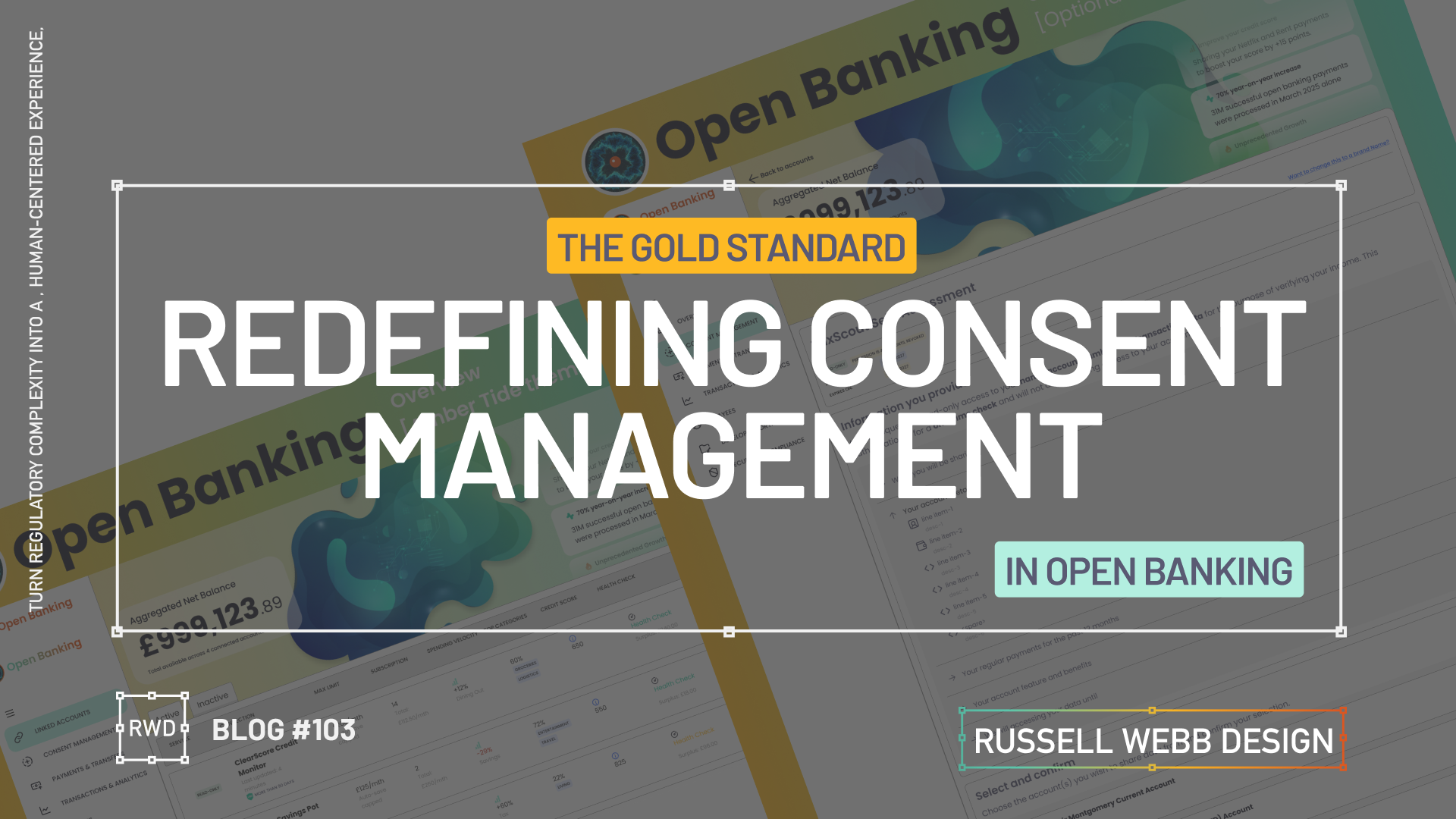
Turn regulatory complexity into a simple, human-centered experience, showing enterprise-level strategic thinking across three touch points.
The Challenge
Section 1
Dashboard UX
Front End UI
Back End Data Systems
Take a cluttered data dump and re-org with applied IA principles to prioritise key metrics to Gold Standard UX.
Understand API constraints and latency through the developers eyes, ensuring the UI is designed gracefully while loading large datasets.
Goal
Implement the Account Information Service Provider (AISP) flow for Open Banking on desktop. Provide users with aggregated financial insights within a complex data Dashboard from multiple sources.
Secondary Goal: To demonstrate strong understanding of front-end interactive design solutions for back-end data systems.
The Problem
Open Banking consent is inherently complex and intimidating for users, leading to high drop-off rates and potential regulatory fines.
Strategic Opportunity: Design a Consent Management Dashboard that not only meets legal requirements (i.e. PSD2, CMA) but also builds trust, by making the flow transparent and effortless.
Business & User Goals
User Success Metric: Allow users to manage their third-party connections with confidence and clarity.
Gathering the principal players
This case study hinges on transforming a fragmented jigsaw of data and key UI elements, into a cohesive, high-trust narrative that fosters familiarity and security.
UX Writing
AI UX Designer
data points
Thinking entity that symbolise Open Banking
As for modern AI-UX designer employing the hybrid model is key:
Human
Journey designing, API and BE driven integrations, and user needs
A simple AI prompt
Create an abstract image graduated amorphous ‘thinking’ entity for a desktop financial dashboard using gradient blues and green
Navigation
An action-oriented, collapsible navigating sidebar needs to balance financial utilities like linked accounts and permission-driven consent while managing who has access to what.

Defining the Gold Standard Row Content
API > Actionable
PromptING In Nano Banana
Shift the data from static information to high-trust insights that prioritises transparency. By balancing security indicators (timestamps, verified credit boost), the interface transforms complex Open Banking API calls into a true financial dashboard.

Prototyping & Flow Design
Section 2
Active consent
Data transparency
Design to steer strategy and make complexity feel simple.
Revoking Permissions
Progressive disclosure
Dashboard UX
Iconography
Financial dashboard
This desktop design for Linked Accounts moves beyond a simple list of connections, transforming a technical requirement into a high-value financial dashboard.


Design Solution
Revoke: A two-step confirmation modal
- Clearly show what is next
- Demonstrate the consequences (i.e. “You will lose access to X)
- Keep the user informed
Prototyping
Goal
Introduced a clickable mid-fidelity prototype to define a concise, step-by-step journey, using a Just-in-Time disclosure model to manage information overload.
Re-connect (or re-authorise)
AISP Flow
ACCOUNT Sharing
Micro-interactions
The Off-Ramp
Simplifying the renewal process with an option to “Re-authorise” with a single click by balancing complex financial data with a user-friendly, high-trust aesthetic.


Design Solution
What data is being shared | Which account | Confirmation
Consolidate Account Identity with real-time Transactional Intelligence and transform fragmented data into a clear feedback that surfaces categorised spend and Live Balances for smarter budgeting, while removing the friction of manual entry.
Prototyping
Goal
Discovery unwanted connections, show transparency by surfacing shared information
and provide control by allowing for a clear account selection process.
Lessons Learnt & Outcomes
Section 3
DATA retention
human-readable insight
Attention to detail in critical flows.
The Just-in-Time Model
Cognitive overload
data retention
Revocation & Renewal
The Takeaway: The “Off-Ramp” (revocation) is just as important for trust as the “On-Ramp” (onboarding). Using a Progressive Disclosure model for revoking permissions prevents information overload.
- Outcome: A two-step confirmation modal for revocation.
- Opportunity: Separating expired consents (< 90 days) from older data (> 90 days) could better inform users about long-term data retention policies.


High-Trust UX
DASHBOARD UX
Security
Using IA to instil trust
The Takeaway: Consent shouldn’t feel like a legal hurdle. It should feel like a security feature. By moving away from a data dump to applied IA, the complexity of PSD2/CMA requirements is rebranded as a transparency benefit.
- Outcome: Gold Standard Row Content model that translates technical API calls into human-readable insights.
- Opportunity: Logical Chunking can reduces cognitive friction, adding a I do not recognise flow with Fraud warning capability goes that extra step.


Figma Tip: Vertical v Horizontal
Component variants: Designing a data-rich Figma table row component with AL responsiveness requires planning. Individual cells should be set-up with component variants, giving the flexibility to swap in complementary formats for differing data points.
Cell Design: For the ultimate flexibility, component cells should be stacked in a vertical AL column, set to (W) Fill.
Outcomes
The project proved that prioritising transparency and control in regulatory design is the highest leverage move. Focus on clear FE design, BE clarity, 90 day consents, and dashboard UX to transform a legal requirement into a trust-building feature.

Go Beyond the Screenshot
Static frames only tell half the story. To truly understand the user journey, you need to feel the interaction. I’ve prepared several high-fidelity Figma prototypes available for walkthroughs.
Advanced prototyping
Auto Layout
Microinteractions
Design Systems

Please Get in touch and request access


Leave a Reply