Tag: open banking

  • Redefining Consent Mngt

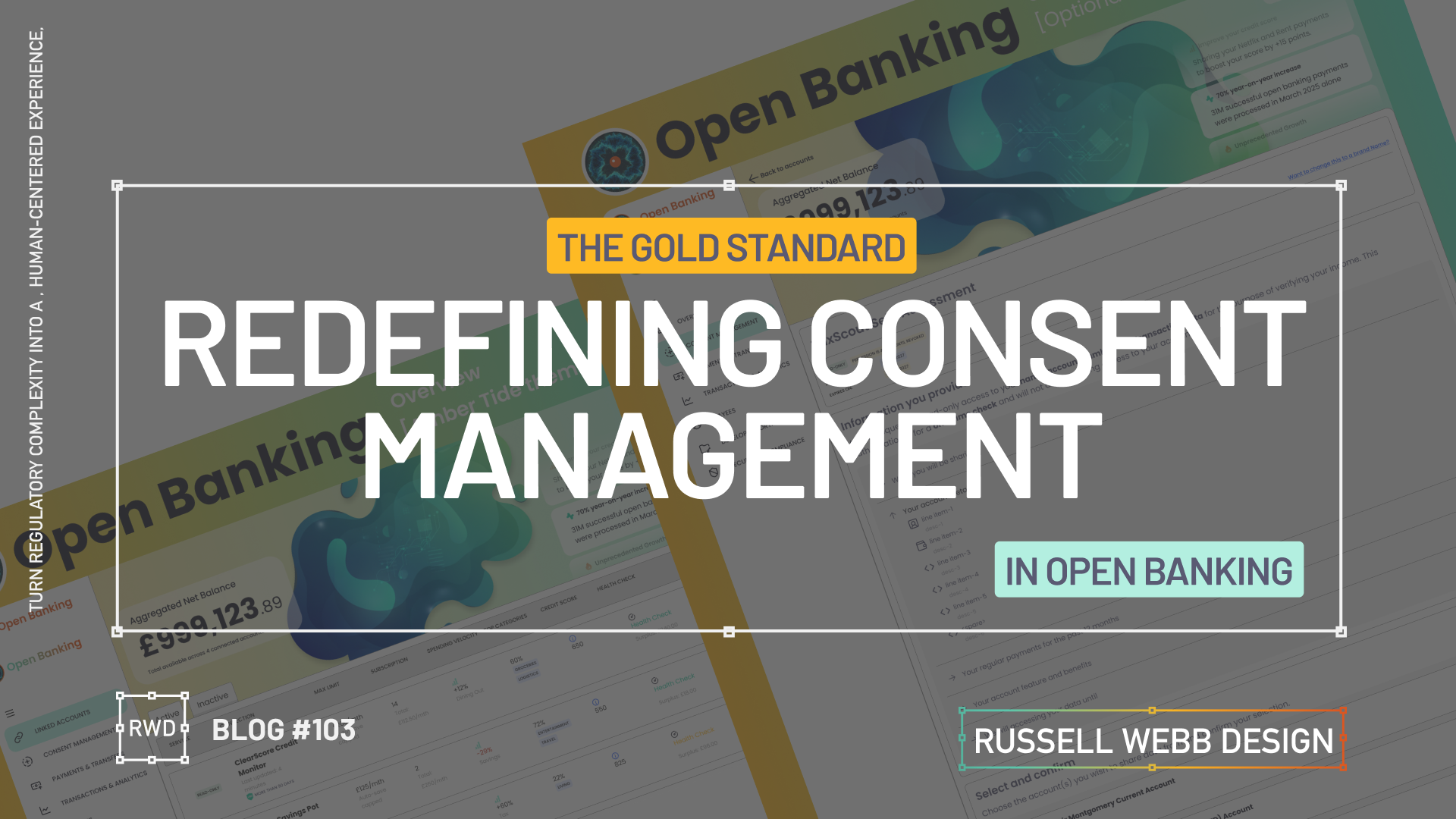
    Redefining Consent Mngt

    Turn regulatory complexity into a human-centered experience, showing enterprise-level strategic thinking across three touch points.

    The Challenge

    Section 1

    Dashboard UX

    Front End UI

    Back End Data Systems

    Take a cluttered data dump and re-org with applied IA principles to prioritise key metrics.

    Understand API constraints and latency through the developers eyes, ensuring the UI is designed gracefully while loading large datasets.

    Goal 

    Implement the Account Information Service Provider (AISP) flow for Open Banking on desktop. Provide users with aggregated financial insights within a complex data Dashboard from multiple sources.

    Secondary Goal: Demonstrate strong understanding of FE interactive design solutions for BE data systems.

    The Problem

    Open Banking consent is inherently complex and intimidating, leading to high drop-off rates and regulatory fines.

    Strategic Opportunity: Design a Consent Management Dashboard that not only meets legal requirements (i.e. PSD2, CMA) but also builds trust, by making the flow transparent and effortless.


    Business & User Goals

    User Success Metric: Allow users to manage their third-party connections with confidence and clarity.

    Gathering the principal players

    This case study hinges on transforming a fragmented jigsaw of data into cohesive, high-trust UX that fosters familiarity and security.

    UX Writing

    AI UX Designer

    Data Points

    Thinking entity to symbolise Open Banking

    This AI-UX designer employs the hybrid model:

    Human

    Journey designing, API and BE driven integrations, and user needs

    A simple AI prompt

    Create an abstract amorphous image, a ‘thinking’ entity for a financial dashboard using gradient blues and green

    Navigation

    An action-oriented, collapsible side nav needs to balance financial utilities (i.e. linked accounts and permission-driven consent) while managing who has access to what.

    To respect confidentiality agreements, the branding and specific naming have been modified. This product is currently live and serving 6k users

    Defining the Gold Standard Row Content

    API > Actionable

    Prompt; Nano Banana

    Shift the data from static information to high-trust insights. By balancing security indicators (timestamps, verified credit boost), the interface transforms complex Open Banking API calls into a true financial dashboard.

    To respect confidentiality agreements, the branding and specific naming have been modified. This product is currently live and serving 10K plus HNW users.

    Lessons Learnt & Outcomes

    Section 3

    DATA retention

    Human-readable insight

    The Just-in-Time Model

    Cognitive overload

    Data retention

    Revocation & Renewal

    The Takeaway: The “Off-Ramp” (revocation) is just as important for trust as the “On-Ramp” (onboarding). A Progressive Disclosure model for revoking permissions prevents information overload.

    • Outcome: A two-step confirmation modal for revocation.
    • Opportunity: Separating expired consents (< 90 days) from older data (> 90 days) could better inform users about long-term data retention policies.

    High-Trust UX

    Dashboard UX

    Security

    Using IA to instil trust

    The Takeaway: Consent shouldn’t feel like a legal hurdle. It should feel like a security feature. By moving away from a data dump to applied IA, the complexity of PSD2/CMA requirements is rebranded as a transparency benefit.

    • Outcome: Gold Standard Row Content model that translates technical API calls into human-readable insights.
    • Opportunity: Logical Chunking can reduces cognitive friction, adding a I do not recognise flow with Fraud warning capability goes that extra step.

    Component variants: Designing a data-rich responsive Figma table row and cell components with auto-layout should be set-up with component variants, giving the flexibility to swap in complementary formats for differing data points.

    Cell Design: For the ultimate flexibility, component cells should be stacked in a vertical AL column, set to (W) Fill.

    Outcomes

    The project proved that prioritising transparency and control in regulatory design is the highest leverage move. Focus on clear FE design, BE clarity, and the details (i.e. 90 day consents) to transform a legal requirement into a trust-building feature.

  • What is the role of open banking in the super app evolution?

    What is the role of open banking in the super app evolution?

    TL;DR Open Banking unlocks a future where financial apps become indispensable partners. A power-shift to more convenience, better financial education and meaningful relationships. Read on to see What’s next in this new ecosystem?


    Hard Skills:

    Journey Mapping

    Research

    Visual Design

    Soft Skills:

    Empathy

    Collaboration

    Critical Thinking

    Full List →


    What is Open Banking

    The role of open banking in the super app evolution is enormous, it is essential for creating a smoother user experience. Open banking is the core technology that allows these apps to draw financial data from multiple sources (APIs) and design products and services that speak to the needs and wants of the end-user.

    Open Banking helps super-apps with:

    • Personalisation: Gathering data to enhance recommendations, habits and trends based on the user’s behaviour.
    • Centralisation: One app to rule-them-all, one roof and one umbrella. No need to switch apps to switch functionality (i.e.make payments, check portfolio performance, monitor transactions, etc).
    • Open finance: Super apps and open banking are foundational pieces in the financial ecosystem jigsaw – mortgages, savings, pensions, insurance and credit, can all talk to each other.

    Super app benefits for wealth management

    The end-user now enjoys luxuries that a few decades ago would seem unimaginable. Wealth Management (WM) was dated and rigid, Financial Institute in pole position, controlling the action. The birth of the super app has tipped the balance of power to the investor, putting them in charge of their finances.

    Convenience

    The super app has evolved to give the consumer (and investment professionals) a one-stop shop for all their finances. Investors used to jump from website to website and from platform to app to check transactions, transfer money, pay bills, etc. Now within is single-pane-of-glass, user control their financial world.

    Smarter decisions

    Phone a banker, broker or accountant to see how their money is affected by fragmented financial knowledge; Financial decisions needed the experts.

    • Did the expert always have your best interest at heart?
    • How close and personal was that relationship with these experts to trust their recommendations
    • How transparent were they?

    The super app brought an dispassionate, clean, and precise approach to financial decision-making. It has trimmed-the-fat off the process, presenting users with the best viable option.

    Enter the financial super app

    A super app alleviates financial institutions from transaction processing, compiling data, building risk profiles and other traditional banking functions. It allows banking institutions to focus on building meaningful relationships with investors.

    It centralises their attention and indirectly allows Portfolio Managers to tailor their campaigns for new products and services. Relationship Managers now know where their audience is; all they have to do is put the right thing in front of them.

    From viewing fund performances to the allocation of assets, to understanding these assets positions, to what transactions have been actioned and reviewing portfolio valuation.

    The future for financial super apps?

    Data management

    Third parties, organisations and fintech companies need to understand

    • Where the data is coming from
    • How they store it
    • How they use it

    This is the way to build bulletproof information flows.

    AI-driven Financial Coaching

    Artificial intelligence in money management apps process data quickly and efficiently. By monitoring financial behaviour, AI can assist users in maintaining smart savings, refinancing, achieving financial goals, and even more*.

    *With approval, of course

    Get in touch

    Want more?

    Discover how FI’s can can offer all clients personalised advice, how UX can help investment firms stay relevant in our neobank world and how to build a *Financial Super App – One click at a time.

    *NDA Case Study Walk-Thru

    It truly is, a Brave New World!

    RussellWebbDesign: Get your fill of UX trends, case studies and best practice