Tag: sketch

  • A Frictionless Wireframe Onboarding Journey

    A Frictionless Wireframe Onboarding Journey

    TL;DR: Customers faced a confusing onboarding maze. Detailed UX wireframes transformed it into a frictionless journey, getting users invested.

    OUTCOME: Secure, and personalised onboarding process building loyalty from the first click.

    UX Wire-Framing

    Multiple Interactions

    Design Thinking

    Enterprise

    How to hook new customers

    Detailed wireframes mapping a user-centred flow that included clear guidance, robust security, and personalisation resulting in a better customer experience, more efficient development, and strong team alignment..

    Backend to Frontend

    When customers make a product selection there is a lot going on behind the scenes. 

    The desktop new product onboarding experience is a complex animal, a prime candidate to wireframe. Capturing a large selection of unique steps and indicating the interaction design is a Design Thinking challenge and requires enterprise-level wire framing skills

    A Frictionless Wireframe Onboarding Journey
    A Frictionless Wireframe Onboarding Journey
    • Clarity and Understanding A central pillar in UCD
    • Take advantage of existing Design System component reuse 
    • Team alignment (from BAs to Dev to client)

    … let’s dive in


    Defining the Problem

    Security

    Hi-Fidelity

    A Frictionless Wireframe Onboarding Journey

    Imagine a new or existing customer discovering your product

    The onboarding process can often feel like a daunting maze. This is where detailed wireframes step-up, transforming a journey into a smooth and secure experience. Early decisions were made to leverage a pre-existing Design System, so high fidelity wireframes (Hi-Fi) became the way forward with Figma as the wire-framing tool of choice. 

    Development Preparation

    Pre-development tech checks

    Process flow diagrams

    A Frictionless Wireframe Onboarding Journey
    A Frictionless Wireframe Onboarding Journey

    The first goal in a wireframing process is technical. The objective is to integrate a robust data gathering mechanism into the onboarding process to streamline technical development. Understanding the terms and conditions, personal details collection, and email and SMS validation data flows and aligning these all to API calls was top-of-mind. 

    This early technical scoping ensures efficient API integration and data management solutions, so the team can move forward and then collaborate with BAs and then UX.

    Onboarding Flow and Requirement Gathering

    Goals

    Objectives

    Functional requirements

    Shared understanding

    A Frictionless Wireframe Onboarding Journey

    Images are blurred for client confidentiality reasons

    BA Requirements Gathering

    To provide a solid foundation, to limit rework and foster communication between stakeholders (users, developers, designers) a Business Analyst will typically conduct user and stakeholder interviews to understand business goals and success metrics, write user stories and generate Use Case Diagrams indicating functional requirements to create a shared understanding before wireframes begin.

    1 – Guiding the First Steps

    Personal details

    Pre-registration

    A Case Study in Wireframing Success

    The process begins the moment a product ID is entered as the customer clicks a product. These wireframes propose a gentle walk-through, hand-holding the customer and setting clear expectations. As personal details are collected, the system identifies pre-registrations, streamlining the experience. For unrecognised products, the UI gracefully handles the situation, preventing frustration.

    A Case Study in Wireframing Success
    Wireframes: From Investment Pledge (Source of Funds) to National Insurance (NI)

    Behance – A FRICTIONLESS WIREFRAME ONBOARDING JOURNEY

    A Frictionless Wireframe Onboarding Journey

    Fine tune the results

    UAT Testing

    Prototyping

    Sneak preview of the final delivered User Interface (UI) 

    The interface has been altered for client confidentiality reasons 

    The process is still fresh, typically these will go through Usability Testing and Heuristic Evaluation. Prototyping, with QAs on standard, is another option to verify and test stakeholder feedback.

    Conclusion and Impact

    Clarify ambiguity

    trust

    Tailored

    These wireframes don’t just showcase a process; they tell a simple story of a complex customer experience. By prioritising clarity, security, and personalisation, even with a level of ambiguity, this onboarding journey fosters trust and loyalty from the very first click.

    Empowering users with the financial tools they deserve. From Mastering Design Theory and Lean Agile, Solve big problems, fast to How delight and speed are rewriting our UX playbooks. See more Case Studies.

    Empowering users with the financial tools they deserve

    • Mastering Design Theory and Lean Agile
    • Solve big problems, fast.
    • How delight and speed are rewriting our UX playbooks

    More Fintech Case Studies

  • Part II; How being more consultative can sooth the UX process – COVID Special

    Part II; How being more consultative can sooth the UX process – COVID Special

    TLDR; Boost your workflow without breaking a Zoom sweat in this COVID-friendly remote special. Simplify KO’s, pinpoint problems, and find your perfect toolset. Unleash the life-saving power of Dual Track UX Delivery. ‍ 

    This is Part II of a two-part article looking at improved Ways of Working from a consultative UX perspective. Please visit Part I: How being more consultative can sooth the UX process – COVID Special to where I focused on;

    • Simplifying the KO process
    • Defining problems to solve
    • Tools and their limits

    Real world examples

    Product inconsistencies

    Moving on from the KO process and tool limits (see Part I). Part II drills down on real world ‘quick wins’, tracking tasks and signposting. Conclusions will sum up.

    Labelling and Buttons

    Focus on your speciality, and reach out when you need help
    Focus on your speciality, and reach out when you need help.

    ‘Quick wins’, including consistency like tracking labelling decisions (with accountability) and pressing the right primary (or secondary) buttons should be your focus as a consultative UX designer.

    This visual how confusion over two descriptions. Custom mapping within DBS is a complicated animal so learn on your front-end developer who has the skills to explain payment endpoints much better than any creative.

    When mental models don’t align

    Identical terminology should be used in prompts, menus, and help screens; and consistent colour, layout, capitalisation, fonts, and so on, should be employed throughout.
    Use the Gestalt ‘Law of Similarity’ principle and keep parallel screens similar.

    The “Law of Similarity” states that elements tend to be perceived into groups, if they are similar to each other. Meaning if you have elements with the same functionality, meanings and hierarchy, they should be visually similar. 

    (more…)
  • Part 1; How being more consultative can sooth the UX process – COVID Special

    Part 1; How being more consultative can sooth the UX process – COVID Special

    TL;DR; Boost your workflow without breaking a Zoom sweat in this COVID-friendly remote special.

    Simplify KO’s, pinpoint problems, and find your perfect toolset—faster than a remote ping. Discover the limits of your daily grind. Then, unleash the life-saving power of Dual Track UX Delivery as a consultative designer. ‍ 


    Hard Skills:

    Journey Mapping

    Research

    Visual Design

    Soft Skills:

    Empathy

    Collaboration

    Critical Thinking

    Full List →


    This is Part 1 of a two-part article looking at improved Ways of Working from a consultative UX perspective. I will be concentrating on;

    Jump forward to Part II, I will be deep-diving into;

    • Real world examples
    • Ways of Working
    • Dual track UX
    • Signposting
    • Conclusion
    • My Top 9 Take-aways
    (more…)
  • Wireframing an on-demand Internet streaming media service

    Wireframing an on-demand Internet streaming media service

    I have been recently working with a colleague on a private project around the world of media streaming. We had got to a level where the tech was getting up to scratch, but the UX was missing.

    So, here it is.

    Download here Download the PDF: OnDemandStreamingService-Mobile_Tablet

    Mobile

    Mobile

    On – screen blueprint representing the skeletal framework of the service. These provide an informed perspective to hit, or in this case, promote what will be business objective and a creative idea. As usual these lacks typographic style, colour, or graphics, as the main focus lies in functionality, behaviour, and priority of content.

    (more…)
  • Wireframing an iPad Casino App

    Wireframing an iPad Casino App

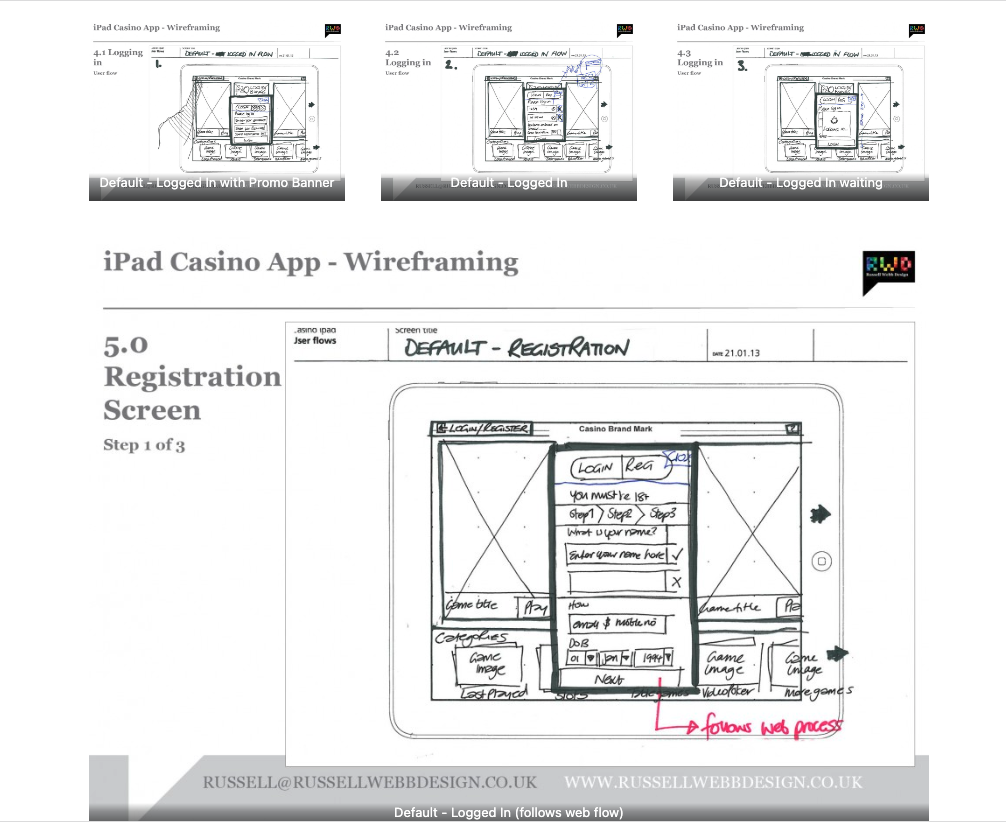
    TLDR: Focusing on planning functionality and layout without design is the most efficient way of concentrating decision markers (especially business or product-owners) to agree on functionality without distraction. Think: function over form.

    Personally I love to use traditional pen and paper for wireframing. How about you?

    First launch feature areas

    This is the main ‘shop window’ to your experience. On first launch, the user to launched in the gambling casino world. Pre-selected games adopt the ‘parallax scrolling’ technique and occupy the prime real estate. There is also functionality to drill down via category types. Account Management and Help are all ‘front-of-store’, as is the ability to push sign up and login promotions.

    CasinoApp_Wireframing3

    (more…)