TL;DR; While the gambling industry continues to boom despite global financial woes, a reliance solely on branding through splash screens has its limitations. This post dives into why your home screen deserves more attention. Showcase promortaionl content, search (as navigation maybe?) and Quick Links as crucial building blocks, including introducing the popular hamburger icon for primary navigation and transform your home screen into landing page(s) into a powerhouse of usability and brand identity.
Next to essentials like food and water, one of the only other industries not effected by the world financial situation is gambling. In fact the industry is booming. There are many UX challenges in designing the perfect game play experience, catering for the green fingered punter all the way through to the seasoned veteran is a difficult balancing act. Plus, as mentioned, in these more straighten times, to be conscious of not forcing the gambling experience on to the more vulnerable.
Splash screen
Modern smartphone don’t need 2-3 seconds to start up, so the original notion of the start-up or splash screen is now redundant. But brands love to position their logo ‘front of stall’ so for this reason, this screen is important. Keep it simple and remember, if you can’t get your brand message over in 2-3 seconds, think about a re-design.
Home
This is the heart of the application, the place to show off what you have to offer – the ‘showcase‘ if you like. So make it impressive, make it big and try your best to impress.
TLDR: Focusing on planning functionality and layout without design is the most efficient way of concentrating decision markers (especially business or product-owners) to agree on functionality without distraction. Think: function over form.
Personally I love to use traditional pen and paper for wireframing. How about you?
First launch feature areas
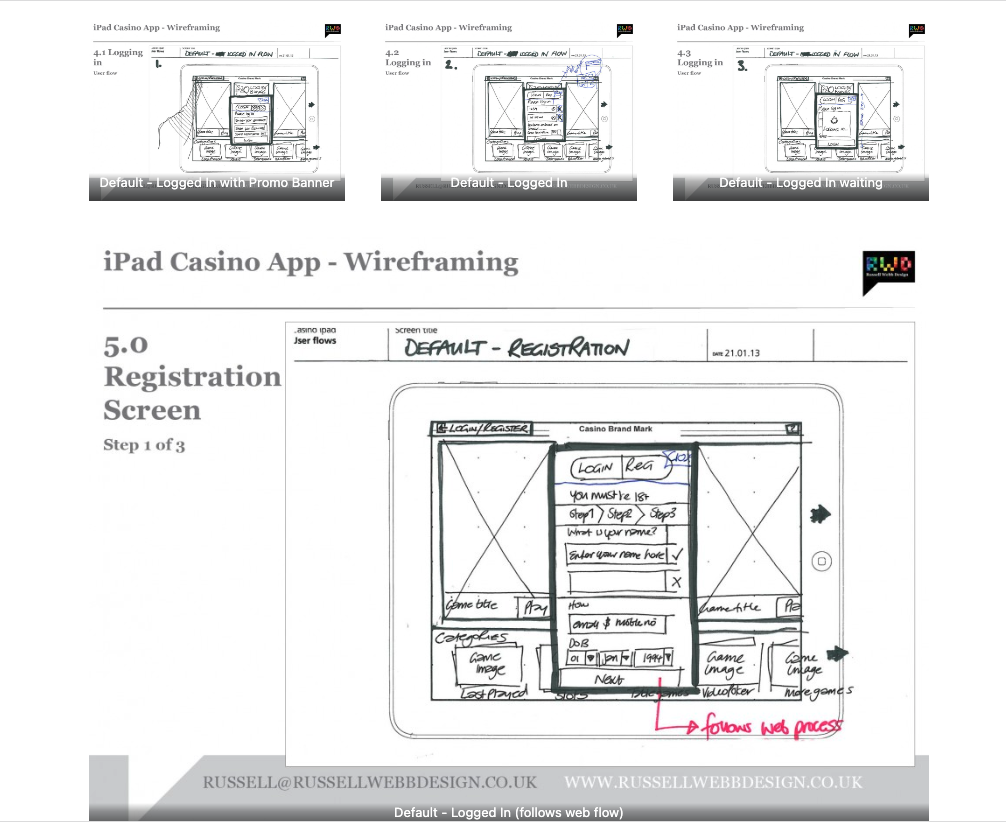
This is the main ‘shop window’ to your experience. On first launch, the user to launched in the gambling casino world. Pre-selected games adopt the ‘parallax scrolling’ technique and occupy the prime real estate. There is also functionality to drill down via category types. Account Management and Help are all ‘front-of-store’, as is the ability to push sign up and login promotions.
TLDR: Skip the fancy prototypes! Low-fidelity sketches are fast, cheap, and encourage better feedback – perfect for early UX stages to focus on functionality before aesthetics.
I’ve made a few assumptions here, first… you work in UX. Second, you’re familiar with Agile and third, you haven’t much time so I’ll keep this brief. Straight to it, here is a couple of the main advantages of low fidelity prototyping:
Get better and more honest feedback
More involved collaboration
Make the cost of mistakes cheap, not expensive
Refine the page flow, not the pages
Figure out the interaction design rather than the visual design
Integrated brand identify both help reputation and consumer awareness. I was tasked with conceptualising a strong brand identity for a new Russian hedge fund. This involves developing routes that generated the tone, style and flavor of the brand across a 2D and 3D environment. This includes, but is not limited to;
I have recently been involved in both high-level concept generation through to territory specific text changes in the exiting world of User Registration. These are my top 5 tips to help you streamline your process or find some inspiration.
1. Do not turn-off your client
Very early on you begin to realise that you, as a UX designer answering to Business and shakeholders alike, should avoid providing a dry and labour-intensive solution to what is a tedious process. This will inevitable put off, or turn off, potential new customers from the start. So, as they walk through your virtual door, try to present a broken-down and achievable process where they can see the light at the end of the tunnel. Don’t forget : Break your offer into bite-sized chunks
Regulations possibly dictate that your customers will need to supply certain information. If so, have them supply that information up-front. That way you, as a caring and customer-centric company can temporally capture that info and call them back should they drop-off. Then you can ask ‘Is everything allright? Can we help you further with your registration?”