Tag: wireframing

  • Real-World Messiness of Product Design

    Real-World Messiness of Product Design

    The commercial mindset of a UX designer ensures outputs aren’t just blue-sky, but shippable. Here I demonstrate how complexity is a daily occurrence, how a proven track record in parallel industries handling multi-layered data and regulatory standards can translate.

    With 15+ yrs exp. I showcase technical fluency with Design Systems, with developer handovers, and platform-specific patterns. Lets dive in…>

    What I personally designed

    To respect confidentiality agreements, the branding and specific naming have been modified. This product is currently live and serving 6k users

    A Portfolio of Reality

    messy

    unclear

    complex Problems

    constraints

    Post release updates

    While defining a real-world business problem, I was able to use UX tools to uncover pain points to inform an initiative UX wireframe flow that in turn, informed the final UI.

    🚀 From Discovery to Design and Solution

    01 Problem Statement: Create a user-friendly and simplified mobile journey that helps seniors mitigate their fraud anxiety, meet financial regulatory standards and ultimately manage their finances i.e. improve their financial wellness.

    This was further expanded with the study into;

    • Low-anxiety mobile payment – Seniors face challenges with mobile payments due to fear of fraud, cognitive load, and digital literacy. Designing a system that addresses these concerns while maintaining security is crucial.
    • Business problem | Design challenge – The challenge is balancing a simplified flow with a robust, secure multi-step flow to mitigate fraud anxiety and meet industry standards.

    02 Segmentation: Identify distinct segments within the aging parent demographic. Target a segment that can most benefit from the UK Payment process. Accessibility, personalisation, security, and financial wellness are key considerations.

    03 Research & Strategy: Use quantitative data with qualitative insights to inform a Customer Journey Map. Visualise the financial and emotional challenges faced by each segment, across a given scenario.

    I prioritised accessibility and task-oriented patterns. Personalised guidance, and minimising cognitive load were also key considerations..

    04 Wire framing Design Decisions: Making trade-offs and delivering a justified UX solution. Simplified to the “What”, the “Who” and “How Much” before a final check then execution. I limited one screen to have one single, clear primary action. Components were dual functioning for  Existing Beneficiary and New Beneficiary reducing two mini journeys to one.

    05 Conclusion & Outcomes: How my decision’s successfully translate a complex real-world business problem into an initiative UX wireframe and Final UI flow.

    Key highlight

    • Key stakeholders audience established 2-months before proposed Sprint through workshopping and client relationships.
    • Pain points highlighted early, including CoP, Secondary payment reference and scope (i.e Feed and FX was descoped)
    • Cross platform UX and UI for Alpha release delivered and demo’d in 3-months
    • Developer and BA handover, Design System integration scheduled early for estimation and to provide clarity
    • Design System integrated and UX Copy Check signed-off
    • No deadlines missed 🙂

    Engineering Constraints and Design Trade-offs

    engineering constraints

    Technical realities

    trade-offs

    final outcome

    International Payments

    International payments is a complex animal. There is a fine line between delivering pixel-perfect cross-platform consistent UI and balancing that against commercial and technician reality. Recently I was in Bug Triage to get this sophisticated and geographically dependent piece of functionality across the line. Lets dive-in ->

    SWIFT/BIC, when connected to an API returns a Bank name, think of it as a post code. While the end-user has the ability to edit this code for new payees, they cannot edit the bank name [engineering constraint]. For a more harmonise UX, new and existing payees should be displayed in a consistent and non-jarring format. So I made the decision to use input fields throughout, in various states.

    My design then changes From > To :

    AI generated: For NDA reasons, I have fast-tracked these Input Fields to rapidly visualise these engineering constraints.

    The Trade-Off

    This manifested itself from an arguably more elegant From execution, to the multi-platform but feature parity To solution following both a trade-off contributing to a non-jarring, smoother, and Input field led consistency experience.

    To give context, this attention to detail was part of a much wider delivery. For NDA reasons, the forms in its full extent (1 of 3), have been altered.

    To respect confidentiality agreements, the branding and specific naming have been modified. This product is currently live and serving 6k users

    The Data-Informed Designer

    Design intuition

    qualitative or quantitative signals

    Post launch

    Retrospective improvments

    How I value results just as much as pixels.

    Dashboard UX to business UI

    Catering for demanding clients requesting instant advice, competitive quotes and investment strategies requires tailored tools, especially within a sensitive client-data environment – Welcome to the a Customer Meeting App Dashboard

    Through team interviews, ad-hoc surveys and gorilla research I defined three “must-have” features early on, so pre-launch the business needs and UX goals were transparent;

    1. Single point of access for disparate data – Five-second insight
    2. Broad overview with drill-down capabilities – Inverted pyramid
    3. Fill other process gaps easier and faster – Champion the brand | DS achievability

    Problem and Opportunity

    The existing offering had become redundant. Integrating data from third-party repositories was a priority, to achieve an improved user journey. This presented an opportunity to re-imagine the complete ‘Create a Customer Meeting’ user journey.

    There was another further top-level requirement; Funding.

    People management point: When competent business executives are supported by UX leaders who articulate good design, bridging the gap between vision and execution, this can build confidence across the entire team to get product delivery across the line.

    See: Career Growth within Design Teams

    Reimagining Client Meetings

    Step 1

    Start with the user needs

    Streamlining the preparation of a meeting, and principally future proofing the Create a Meeting process with a scalable UI that can seamlessly integrate new data repositories, ensuring long-term flexibility.

    Step 2

    Segment in to ‘zones’

    The on-screen real estate delivers a quick look experience prioritising top from bottom.

    Step 3

    Test and Challenge through Prototyping

    Visualising up to 12 users’ journeys leads to better understanding and smoother development. Boxed development will not impact working code.

    Early sketches reveal the potential of a dashboard, emphasising hierarchy through top-down, LTR user scanning patterns, pushing a hierarchical arrangement that guides the user’s eye. Data is prioritised with glance-access to preview Meeting Name top-of-mind expanding and collapsing information depending what is scope. 

    A conceptual dashboard with multiple layers

    The final solution solved both the scalability problem, providing easy access to account numbers, the ability to add other account numbers, visibility on the meeting date and time, and the meeting status and who is the meeting organiser. Complete transparency on meeting detail, including location, meeting language and notes format with extra features like Meeting Packs.

    And the results speak for themselves
    190 offices | Growth from 8% to 56% | 1.5 years

    Quantitative Signals

    The quantitative metric as a single-source-of-truth of unifying insights speak volumes: 56% iPad growth in just 1.5 years over 100K client meetings in 40 countries with approximately half of their approx 85 offices in western Europe,

    From business problem to an Enterprise-level, real-time data dashboard from multiple sources, instantly accessed, no more hunting.

    Qualitative Design Trade-Offs

    On reflection post launch, one key factor in the development (and acceptance) of this new radical design was achievability. Funding is also a key developmental constraint so designing with business realities is key. This inevitably constrains blue-sky thinking, a real change outside of budget and possibly a missed opportunity was to re-pitch this design for responsively iPad (landscape and portrait) or to expand on the ‘mini’ and  ‘maxi’ concept from full disclosure down to dashboard snippets. Maybe in Phase 2!

    Career Growth within Design Teams

    How to hook new customers

    Ambiguity

    Ownership

    Resourcefulness

    When customers make a product selection there is a lot going on behind the scenes. Desktop new product onboarding carries a lot of functional weight, it is a prime candidate to wireframe. Capturing a large selection of unique steps requires enterprise-level wire framing skills.

    Defining the Problem

    Imagine a new or existing customer discovering your product. The onboarding process can often feel like a daunting maze. This is where detailed wireframes step-up, transforming a journey into a smooth, secure and clear experience. Early decisions were made to leverage a pre-existing Design System. High fidelity wireframes became the way forward with Figma as the wire-framing tool of choice. 

    Onboarding Flow & Development Preparation

    Process flow diagrams were thin on the ground, little research was available and there was a lot of ambiguity. This was an opportunity! I took it on myself to deeply understand how personal details were collected, how email and SMS validation data flows worked, understand business goals and success metrics, so the technical team can move forward. This was a calculated risk!

    Segmenting the UX Wire-framing Process

    1 – Guiding the First Steps

    Personal details

    Pre-registration

    The process begins the moment a product ID is entered as the customer clicks a product. These wireframes propose a gentle walk-through, hand-holding the customer and setting clear expectations. As personal details are collected, the system identifies pre-registrations, streamlining the experience. For unrecognised products, the UI gracefully handles the situation, preventing frustration.

    2 – Building Trust and Security

    KYC process

    Tax jurisdiction

    GDPR

    IDV

    Next, the validation screen requests a unique member ID, followed by a secure OTP process. This includes both email and mobile verification, paving the way for a robust KYC process.

    The customer identifies their tax jurisdiction, providing identification proof, as part of a seamless IDV (Identity Verification) experience. To ensure compliance with regional regulations, the system also gathers marketing and accessibility permissions, adhering to GDPR guidelines.

    3 – Personalisation Meets Regulation

    Investment pledge

    NI (UK)

    This joined-up onboarding process seamlessly transitions the customer from initial product selection to specifying their investment pledge.  Furthermore, their National Insurance ID is verified, ensuring 360˚ compliance.

    4 – A Smooth Conclusion

    Confirm Message

    Next steps

    UAT Testing

    Prototyping

    Finally, once all data is collected, it’s securely transmitted to the BE. The FE then provides clear messaging, confirming a successful onboarding experience. This leaves the customer feeling confident and ready for next steps. Wires were shared for feedback across the team, including stakeholder, technical leads and PO’s.

    Fine tune the results

    Sneak preview of the final delivered User Interface (UI)

    The process is still fresh, typically next steps are Usability Testing and Heuristic Evaluation. Prototyping, with QAs on standby, is another option to verify and test stakeholder feedback.

    Conclusion and Impact

    Ambiguity

    Clarity

    These wireframes don’t just showcase a process; they tell a simple story of a complex customer experience.

    By prioritising clarity (onboarding steps) and security (verification and OTP) this onboarding journey fosters trust and loyalty from the very first click.

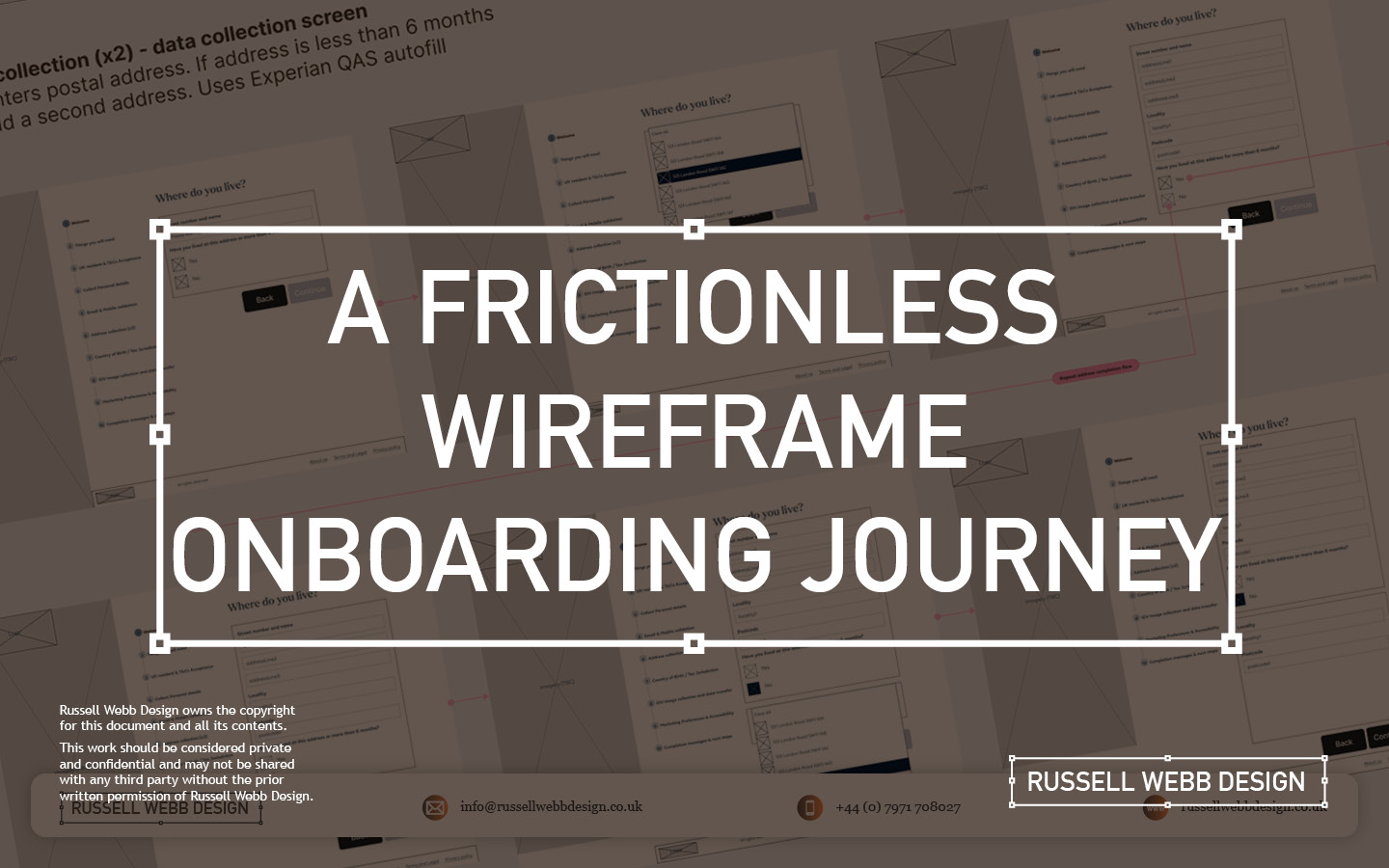
  • A Frictionless Wireframe Onboarding Journey

    A Frictionless Wireframe Onboarding Journey

    TL;DR: Customers faced a confusing onboarding maze. Detailed UX wireframes transformed it into a frictionless journey, getting users invested.

    OUTCOME: Secure, and personalised onboarding process building loyalty from the first click.

    UX Wire-Framing

    Multiple Interactions

    Design Thinking

    Enterprise

    How to hook new customers

    Detailed wireframes mapping a user-centred flow that included clear guidance, robust security, and personalisation resulting in a better customer experience, more efficient development, and strong team alignment..

    Backend to Frontend

    When customers make a product selection there is a lot going on behind the scenes. 

    The desktop new product onboarding experience is a complex animal, a prime candidate to wireframe. Capturing a large selection of unique steps and indicating the interaction design is a Design Thinking challenge and requires enterprise-level wire framing skills

    A Frictionless Wireframe Onboarding Journey
    A Frictionless Wireframe Onboarding Journey
    • Clarity and Understanding A central pillar in UCD
    • Take advantage of existing Design System component reuse 
    • Team alignment (from BAs to Dev to client)

    … let’s dive in


    Defining the Problem

    Security

    Hi-Fidelity

    A Frictionless Wireframe Onboarding Journey

    Imagine a new or existing customer discovering your product

    The onboarding process can often feel like a daunting maze. This is where detailed wireframes step-up, transforming a journey into a smooth and secure experience. Early decisions were made to leverage a pre-existing Design System, so high fidelity wireframes (Hi-Fi) became the way forward with Figma as the wire-framing tool of choice. 

    Development Preparation

    Pre-development tech checks

    Process flow diagrams

    A Frictionless Wireframe Onboarding Journey
    A Frictionless Wireframe Onboarding Journey

    The first goal in a wireframing process is technical. The objective is to integrate a robust data gathering mechanism into the onboarding process to streamline technical development. Understanding the terms and conditions, personal details collection, and email and SMS validation data flows and aligning these all to API calls was top-of-mind. 

    This early technical scoping ensures efficient API integration and data management solutions, so the team can move forward and then collaborate with BAs and then UX.

    Onboarding Flow and Requirement Gathering

    Goals

    Objectives

    Functional requirements

    Shared understanding

    A Frictionless Wireframe Onboarding Journey

    Images are blurred for client confidentiality reasons

    BA Requirements Gathering

    To provide a solid foundation, to limit rework and foster communication between stakeholders (users, developers, designers) a Business Analyst will typically conduct user and stakeholder interviews to understand business goals and success metrics, write user stories and generate Use Case Diagrams indicating functional requirements to create a shared understanding before wireframes begin.

    1 – Guiding the First Steps

    Personal details

    Pre-registration

    A Case Study in Wireframing Success

    The process begins the moment a product ID is entered as the customer clicks a product. These wireframes propose a gentle walk-through, hand-holding the customer and setting clear expectations. As personal details are collected, the system identifies pre-registrations, streamlining the experience. For unrecognised products, the UI gracefully handles the situation, preventing frustration.

    A Case Study in Wireframing Success
    Wireframes: From Investment Pledge (Source of Funds) to National Insurance (NI)

    Behance – A FRICTIONLESS WIREFRAME ONBOARDING JOURNEY

    A Frictionless Wireframe Onboarding Journey

    Fine tune the results

    UAT Testing

    Prototyping

    Sneak preview of the final delivered User Interface (UI) 

    The interface has been altered for client confidentiality reasons 

    The process is still fresh, typically these will go through Usability Testing and Heuristic Evaluation. Prototyping, with QAs on standard, is another option to verify and test stakeholder feedback.

    Conclusion and Impact

    Clarify ambiguity

    trust

    Tailored

    These wireframes don’t just showcase a process; they tell a simple story of a complex customer experience. By prioritising clarity, security, and personalisation, even with a level of ambiguity, this onboarding journey fosters trust and loyalty from the very first click.

    Empowering users with the financial tools they deserve. From Mastering Design Theory and Lean Agile, Solve big problems, fast to How delight and speed are rewriting our UX playbooks. See more Case Studies.

    Empowering users with the financial tools they deserve

    • Mastering Design Theory and Lean Agile
    • Solve big problems, fast.
    • How delight and speed are rewriting our UX playbooks

    More Fintech Case Studies

  • Wireframing an on-demand Internet streaming media service

    Wireframing an on-demand Internet streaming media service

    I have been recently working with a colleague on a private project around the world of media streaming. We had got to a level where the tech was getting up to scratch, but the UX was missing.

    So, here it is.

    Download here Download the PDF: OnDemandStreamingService-Mobile_Tablet

    Mobile

    Mobile

    On – screen blueprint representing the skeletal framework of the service. These provide an informed perspective to hit, or in this case, promote what will be business objective and a creative idea. As usual these lacks typographic style, colour, or graphics, as the main focus lies in functionality, behaviour, and priority of content.

    (more…)
  • What’s your favourite wire-framing style?

    wireframingMontage

    Pick your battles, know your styles

    Whether for desktops, on a tablet or the this mythical idea of a mobile internet (there is only one web to experience – but that a different post!) the modern UX-er should be skilled in the art of wire-framing. The style you use should come from the answers to these three things:

    • Process – From low-fidelity through to fully functioning prototypes is the sure-fire route to excellence. In reality, how often does this really happen. If you have enforce a process, I would insist on the sketching and on the final design stages.
    • Resources – I have sat in top-level boardroom meetings in the most stylish settings in the capital, tea and coffee from all over the world. Clearly, resources were not a factor here – so you would be expected to know Azure inside out and be expected to roll-out full functioning Fireworks prototypes. You may even get some business heads thinking your protoypes were so good , it’s a done job!
    • Quick turnaround – Picture the scenario, your stakeholder is looking for a quick – fix. You have fought your corner but there are no requirements, no analysis, no nothing. Always try to push for more than a few scribbles on the back of napkin but sometimes it is more productive just to get on with it.

    Depending on the answers to these issues will depend on the wireframing style you deploy

    responsiveEx
    (more…)