Category: +Tailored

A vital resource for practitioners seeking to sharpen their tools and elevate their work. Beyond surface-level principles, here I dissected interaction design patterns, complex IA challenges, and rigorous user research methodologies. Each post offers actionable insights addressing the nuances of cognitive load, accessibility standards, and design system governance.

  • Real-World Messiness of Product Design

    Real-World Messiness of Product Design

    The commercial mindset of a UX designer ensures outputs aren’t just blue-sky, but shippable. Here I demonstrate how complexity is a daily occurrence, how a proven track record in parallel industries handling multi-layered data and regulatory standards can translate.

    With 15+ yrs exp. I showcase technical fluency with Design Systems, with developer handovers, and platform-specific patterns. Lets dive in…>

    What I personally designed

    To respect confidentiality agreements, the branding and specific naming have been modified. This product is currently live and serving 6k users

    A Portfolio of Reality

    messy

    unclear

    complex Problems

    constraints

    Post release updates

    While defining a real-world business problem, I was able to use UX tools to uncover pain points to inform an initiative UX wireframe flow that in turn, informed the final UI.

    🚀 From Discovery to Design and Solution

    01 Problem Statement: Create a user-friendly and simplified mobile journey that helps seniors mitigate their fraud anxiety, meet financial regulatory standards and ultimately manage their finances i.e. improve their financial wellness.

    This was further expanded with the study into;

    • Low-anxiety mobile payment – Seniors face challenges with mobile payments due to fear of fraud, cognitive load, and digital literacy. Designing a system that addresses these concerns while maintaining security is crucial.
    • Business problem | Design challenge – The challenge is balancing a simplified flow with a robust, secure multi-step flow to mitigate fraud anxiety and meet industry standards.

    02 Segmentation: Identify distinct segments within the aging parent demographic. Target a segment that can most benefit from the UK Payment process. Accessibility, personalisation, security, and financial wellness are key considerations.

    03 Research & Strategy: Use quantitative data with qualitative insights to inform a Customer Journey Map. Visualise the financial and emotional challenges faced by each segment, across a given scenario.

    I prioritised accessibility and task-oriented patterns. Personalised guidance, and minimising cognitive load were also key considerations..

    04 Wire framing Design Decisions: Making trade-offs and delivering a justified UX solution. Simplified to the “What”, the “Who” and “How Much” before a final check then execution. I limited one screen to have one single, clear primary action. Components were dual functioning for  Existing Beneficiary and New Beneficiary reducing two mini journeys to one.

    05 Conclusion & Outcomes: How my decision’s successfully translate a complex real-world business problem into an initiative UX wireframe and Final UI flow.

    Key highlight

    • Key stakeholders audience established 2-months before proposed Sprint through workshopping and client relationships.
    • Pain points highlighted early, including CoP, Secondary payment reference and scope (i.e Feed and FX was descoped)
    • Cross platform UX and UI for Alpha release delivered and demo’d in 3-months
    • Developer and BA handover, Design System integration scheduled early for estimation and to provide clarity
    • Design System integrated and UX Copy Check signed-off
    • No deadlines missed 🙂

    Engineering Constraints and Design Trade-offs

    engineering constraints

    Technical realities

    trade-offs

    final outcome

    International Payments

    International payments is a complex animal. There is a fine line between delivering pixel-perfect cross-platform consistent UI and balancing that against commercial and technician reality. Recently I was in Bug Triage to get this sophisticated and geographically dependent piece of functionality across the line. Lets dive-in ->

    SWIFT/BIC, when connected to an API returns a Bank name, think of it as a post code. While the end-user has the ability to edit this code for new payees, they cannot edit the bank name [engineering constraint]. For a more harmonise UX, new and existing payees should be displayed in a consistent and non-jarring format. So I made the decision to use input fields throughout, in various states.

    My design then changes From > To :

    AI generated: For NDA reasons, I have fast-tracked these Input Fields to rapidly visualise these engineering constraints.

    The Trade-Off

    This manifested itself from an arguably more elegant From execution, to the multi-platform but feature parity To solution following both a trade-off contributing to a non-jarring, smoother, and Input field led consistency experience.

    To give context, this attention to detail was part of a much wider delivery. For NDA reasons, the forms in its full extent (1 of 3), have been altered.

    To respect confidentiality agreements, the branding and specific naming have been modified. This product is currently live and serving 6k users

    The Data-Informed Designer

    Design intuition

    qualitative or quantitative signals

    Post launch

    Retrospective improvments

    How I value results just as much as pixels.

    Dashboard UX to business UI

    Catering for demanding clients requesting instant advice, competitive quotes and investment strategies requires tailored tools, especially within a sensitive client-data environment – Welcome to the a Customer Meeting App Dashboard

    Through team interviews, ad-hoc surveys and gorilla research I defined three “must-have” features early on, so pre-launch the business needs and UX goals were transparent;

    1. Single point of access for disparate data – Five-second insight
    2. Broad overview with drill-down capabilities – Inverted pyramid
    3. Fill other process gaps easier and faster – Champion the brand | DS achievability

    Problem and Opportunity

    The existing offering had become redundant. Integrating data from third-party repositories was a priority, to achieve an improved user journey. This presented an opportunity to re-imagine the complete ‘Create a Customer Meeting’ user journey.

    There was another further top-level requirement; Funding.

    People management point: When competent business executives are supported by UX leaders who articulate good design, bridging the gap between vision and execution, this can build confidence across the entire team to get product delivery across the line.

    See: Career Growth within Design Teams

    Reimagining Client Meetings

    Step 1

    Start with the user needs

    Streamlining the preparation of a meeting, and principally future proofing the Create a Meeting process with a scalable UI that can seamlessly integrate new data repositories, ensuring long-term flexibility.

    Step 2

    Segment in to ‘zones’

    The on-screen real estate delivers a quick look experience prioritising top from bottom.

    Step 3

    Test and Challenge through Prototyping

    Visualising up to 12 users’ journeys leads to better understanding and smoother development. Boxed development will not impact working code.

    Early sketches reveal the potential of a dashboard, emphasising hierarchy through top-down, LTR user scanning patterns, pushing a hierarchical arrangement that guides the user’s eye. Data is prioritised with glance-access to preview Meeting Name top-of-mind expanding and collapsing information depending what is scope. 

    A conceptual dashboard with multiple layers

    The final solution solved both the scalability problem, providing easy access to account numbers, the ability to add other account numbers, visibility on the meeting date and time, and the meeting status and who is the meeting organiser. Complete transparency on meeting detail, including location, meeting language and notes format with extra features like Meeting Packs.

    And the results speak for themselves
    190 offices | Growth from 8% to 56% | 1.5 years

    Quantitative Signals

    The quantitative metric as a single-source-of-truth of unifying insights speak volumes: 56% iPad growth in just 1.5 years over 100K client meetings in 40 countries with approximately half of their approx 85 offices in western Europe,

    From business problem to an Enterprise-level, real-time data dashboard from multiple sources, instantly accessed, no more hunting.

    Qualitative Design Trade-Offs

    On reflection post launch, one key factor in the development (and acceptance) of this new radical design was achievability. Funding is also a key developmental constraint so designing with business realities is key. This inevitably constrains blue-sky thinking, a real change outside of budget and possibly a missed opportunity was to re-pitch this design for responsively iPad (landscape and portrait) or to expand on the ‘mini’ and  ‘maxi’ concept from full disclosure down to dashboard snippets. Maybe in Phase 2!

    Career Growth within Design Teams

    How to hook new customers

    Ambiguity

    Ownership

    Resourcefulness

    When customers make a product selection there is a lot going on behind the scenes. Desktop new product onboarding carries a lot of functional weight, it is a prime candidate to wireframe. Capturing a large selection of unique steps requires enterprise-level wire framing skills.

    Defining the Problem

    Imagine a new or existing customer discovering your product. The onboarding process can often feel like a daunting maze. This is where detailed wireframes step-up, transforming a journey into a smooth, secure and clear experience. Early decisions were made to leverage a pre-existing Design System. High fidelity wireframes became the way forward with Figma as the wire-framing tool of choice. 

    Onboarding Flow & Development Preparation

    Process flow diagrams were thin on the ground, little research was available and there was a lot of ambiguity. This was an opportunity! I took it on myself to deeply understand how personal details were collected, how email and SMS validation data flows worked, understand business goals and success metrics, so the technical team can move forward. This was a calculated risk!

    Segmenting the UX Wire-framing Process

    1 – Guiding the First Steps

    Personal details

    Pre-registration

    The process begins the moment a product ID is entered as the customer clicks a product. These wireframes propose a gentle walk-through, hand-holding the customer and setting clear expectations. As personal details are collected, the system identifies pre-registrations, streamlining the experience. For unrecognised products, the UI gracefully handles the situation, preventing frustration.

    2 – Building Trust and Security

    KYC process

    Tax jurisdiction

    GDPR

    IDV

    Next, the validation screen requests a unique member ID, followed by a secure OTP process. This includes both email and mobile verification, paving the way for a robust KYC process.

    The customer identifies their tax jurisdiction, providing identification proof, as part of a seamless IDV (Identity Verification) experience. To ensure compliance with regional regulations, the system also gathers marketing and accessibility permissions, adhering to GDPR guidelines.

    3 – Personalisation Meets Regulation

    Investment pledge

    NI (UK)

    This joined-up onboarding process seamlessly transitions the customer from initial product selection to specifying their investment pledge.  Furthermore, their National Insurance ID is verified, ensuring 360˚ compliance.

    4 – A Smooth Conclusion

    Confirm Message

    Next steps

    UAT Testing

    Prototyping

    Finally, once all data is collected, it’s securely transmitted to the BE. The FE then provides clear messaging, confirming a successful onboarding experience. This leaves the customer feeling confident and ready for next steps. Wires were shared for feedback across the team, including stakeholder, technical leads and PO’s.

    Fine tune the results

    Sneak preview of the final delivered User Interface (UI)

    The process is still fresh, typically next steps are Usability Testing and Heuristic Evaluation. Prototyping, with QAs on standby, is another option to verify and test stakeholder feedback.

    Conclusion and Impact

    Ambiguity

    Clarity

    These wireframes don’t just showcase a process; they tell a simple story of a complex customer experience.

    By prioritising clarity (onboarding steps) and security (verification and OTP) this onboarding journey fosters trust and loyalty from the very first click.

  • Raising the bar for customer-facing support UX

    Raising the bar for customer-facing support UX

    TLDR: An AI-Powered Customer Service Revolution – AI is transforming customer service by offering personalised solutions, and UX plays a crucial role in creating intuitive and engaging CX.

    Revolutionising Customer Service

    AI-Powered Solutions for Financial Institutions

    AI revolutions

    Personalisation

    Discover how AI is transforming customer service in the financial industry. Learn about personalised knowledge bases, integrated chatbots, and unified customer histories that enhance customer satisfaction and operational efficiency.
    To respect confidentiality agreements, the branding and specific naming have been modified. This product is currently live and serving 6k users

    Imagine a world where customer service is not just efficient but truly personalised.

    The Challenge: In today’s fast-paced digital age, financial institutions face the challenge of providing exceptional customer support while maintaining operational efficiency.

    Traditional customer service UX often falls short in meeting the diverse needs and expectations of modern customers.

    The Solution: This case study explores how AI can revolutionise customer service by creating seamless support and behind-the-scenes tools that put people and businesses in control of their money.

    User research and UX Design

    Ability <> Access <> TIME

    Quick

    Facts

    HIstory

    What the product needs to accomplish.

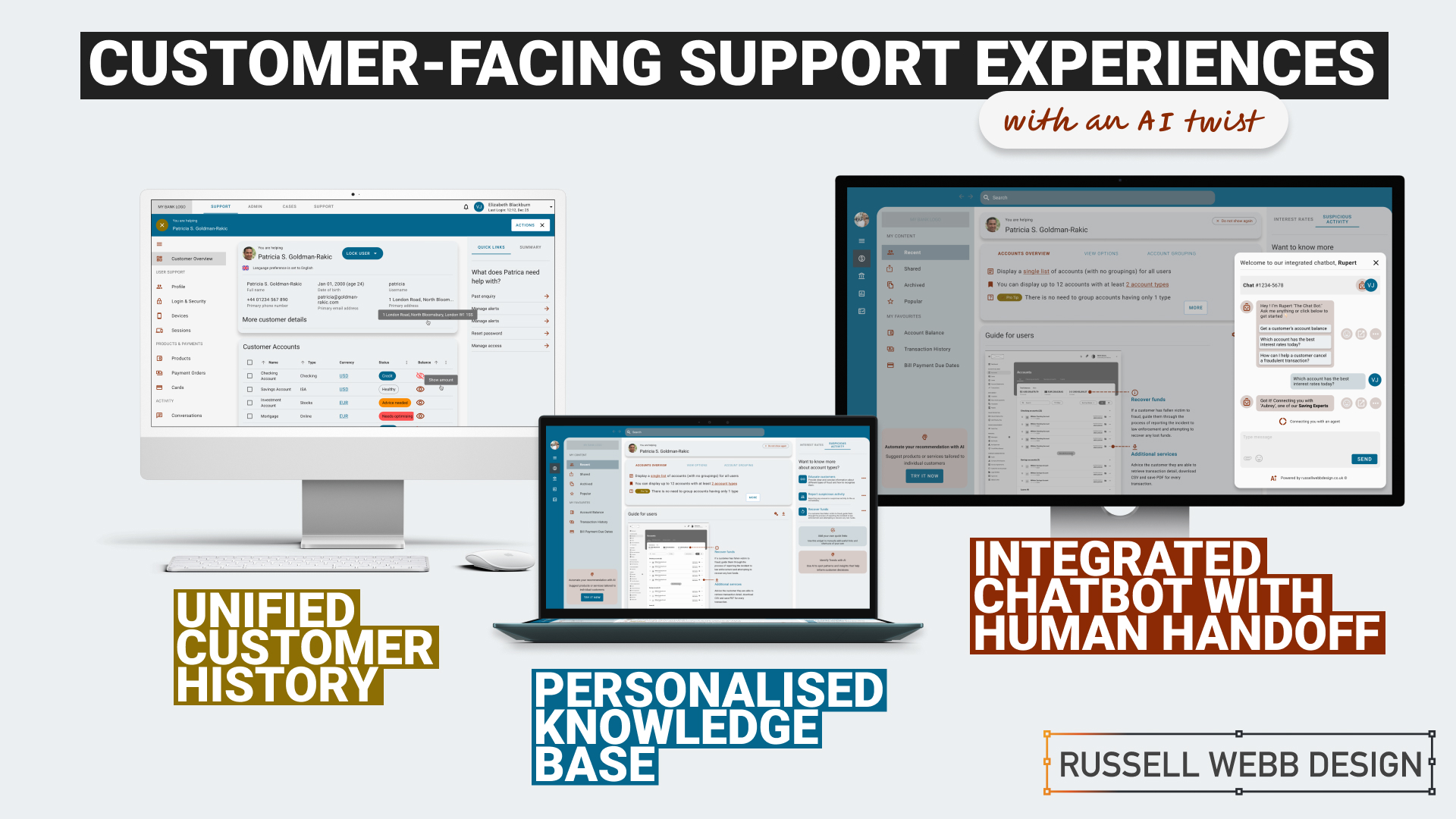
    Evidence informs that Customer Service Representative (CSR) typically operate on multiple panes of glass. Extracting snippets of information to help customers, within the guardrails of their abilities, their access and a timeframe (a phone call). How can this be combined, for the CSR, and potentially for self-serving customers?

    Three persona-types, three outputs;

    1. Mr ‘Self-service’; They need a tool highlighting quick-and-easy answers to their questions, without having to contact a CSR.

    CSR can also provide support and is able to troubleshoot issues and resolve customer problems to deeper issues.

    2. Mrs ‘To-the-point’; Some customers want only the facts, escalating issues to a human CSR when necessary.

    3. Mr ‘Analytical’; CSRs need to have a complete understanding of a customer’s history in order to provide effective support.

    Developing a user centred mode

    To respect confidentiality agreements, the branding and specific naming have been modified. This product is currently live and serving 6k users

    Machine learning

    Self-Service

    knowledge Hub

    Chatbot

    Chatbot

    Personalised recommendations, automating routine tasks, (like FAQs) and predictive analytics are just some of the benefits Machine Learning has in the field of UX Customer Service.

    It was clear for this project there was no one silver bullet. Providing a suite of support from self-service to employing Natural Language Processing (NLP) can all contribute to improving the overall customer experience. Understanding the wealth of possibilities Artificial Intelligence can provide, there was a focussed on three key areas: 

    1. Personalised Knowledge Base

    An AI-powered knowledge base that proactively suggests relevant articles or FAQs based on the customer’s specific query. More about ‘Proactive Suggestion’ later.

    2. Integrated Chatbots with Human Handoff

    Allowing the AI to analyse customer sentiment enables the bot and the CSR to tailor their responses to better meet customer needs and improve satisfaction.

    3. Unified Customer History

    A centralised platform that provides agents with a complete view of a customer’s interactions, including past inquiries, support cases, proactively alerts, and account history.

    History

    Trends

    knowledge Hub

    Proactive Suggestion

    AI can anticipate customer needs and offer solutions before the customer even asks through machine learning algorithms (customer’s history, product information and industry trends ) to predict proactively.

    For example: recommending accessories to recently purchased items, offering troubleshooting tips if a customer has contacted support multiple times, etc. 

    Here the AI recognises this customer has recently been the victim of fraud (see Account Overview note). The right sidebar offers a platform for the UI to proactively generate helpful links to the CSR before they have even asked.


    Self service

    conversational UI

    Unified History

    Process and Impact

    Refined wireframes, optimise self-service and conversational AI

    Starting with several wire-framed directions, then through osmosis filtered down concepts to self-service, a conversational UI and omnichannel integration within the form of a centralised platform. Based on experience and number of assumptions, wireframes were generated to bolster clarification.

    Variants evolved in parallel that merged into a winning model for all three proposals;

    Self Service and Hyper-Personalisation 

    Proactively suggestion, relevant articles and FAQs

    A Personalised Knowledge Base empowers customers to self-serve, with dual-function to help CSR agents to provide targeted support. Aligned to business objectives, these external and internal tools thrive on individual customer data, preferences and behaviour.

    A Personalised Knowledge Base empowers customers to self-serve, with dual-function to help CSR agents to provide support.
    The Customer

    Customers are presented with a user-friendly interface to reduce wait times. Empowered customers can self-serve by searching for documents, tutorials (or anything), related to their query. They have prompted categories to help with Discovery and personalised topics that are trending today. 

    On login, the user is greeted with an app-like interface. This contemporary approach guides them through top-level categories, i.e. Personal and Business finance, then using a navigation as a signpost they are able to drill-down on an Account Overview and User Guide. Tailored topics are surfaced (based on search and account history) within the sidebar quick links.

    The interface has push-points throughout all sections both introduce AI recommendations and provide personalised AI financial insight.

    The CSR

    Using the same B2C interface, CSR agents can access and add-to content, generate most frequently asked self-service tutorials and use the Knowledge Base to improve their own skills.

    Conversational Interface with Human Handoff

    Human-AI Hybrid 

    A smooth transition from AI chatbot, with ‘sentiment analysis’ baked-in, to a human agent 

    An AI chatbot that can handle simple inquiries but seamlessly transitions to a human agent when the conversation becomes complex or requires personalised assistance. This hand-over reduces agent workload for routine queries which improves customer satisfaction with faster responses, but also ensures a smooth transition to human support when needed.

    Chatbot Journey

    From Start through Engagement to Conclusion 

    Natural Language Processing (NLP)

    Gauge customer emotions from an AI-Chatbot that uses sentiment analysis baked-in.

    Properly trained, the AI can recognise the underlying intent behind customer queries, even if expressed differently and provide the right hand-off to the right CSR.

    Unified Customer History

    360˚ View

    A centralised platform | An assistant that proactively spot patterns to anticipate customer needs

    A centralised platform that provides agents with a complete view of a customer’s interactions, including past inquiries, support cases, account history and proactively alerts. For example, if a customer is nearing their contract expiration and has a high purchase frequency, the platform could proactively offer renewal terms or upsell opportunities.

    A single platform to access all customer interaction data: 

    • Reduces the need for customers to repeat information 
    • Enables agents to provide personalised and informed assistance
    • Spot patterns and insights that might inform business decisions
    • Anticipate customer needs and provide timely solutions with proactive support
    To respect confidentiality agreements, the branding and specific naming have been modified. This product is currently live and serving 6k users

    Reduce workload

    Data Insight

    Personalisation

    360˚

    Outcomes, split by discipline

    It is clear that AI enhances personalisation, efficiency, and problem-solving. But how can UX leverage these to create a more human experience.

    Business Outcomes:

    • Operational Efficiency: AI streamlines processes and reduces agent workload.
    • Data-Driven Insights: AI provides valuable customer data for informed decisions.
    • Cost Reduction: AI automates tasks and reduces operational costs.

    UX Outcomes:

    • Personalisation: AI can tailor the Self-Service experience, and brings Hyper-Personalisation to individual needs.
    • Seamlessness: AI integrates chatbots and provides a unified customer view.
    • Proactive Support: AI anticipates customer needs to find answers fast and can provide that 360 view at-a-glance.

    UX & AI | Future-proof partners

    Overall, UX and AI empowers businesses to deliver exceptional customer experiences, improve efficiency, and gain that competitive edge.

    Empowering users with the financial tools they deserve. From Mastering Design Theory and Lean Agile, Solve big problems, fast to How delight and speed are rewriting our UX playbooks. See more Case Studies.

    Empowering users with the financial tools they deserve

    • Mastering Design Theory and Lean Agile
    • Solve big problems, fast.
    • How delight and speed are rewriting our UX playbooks

    More Fintech Case Studies

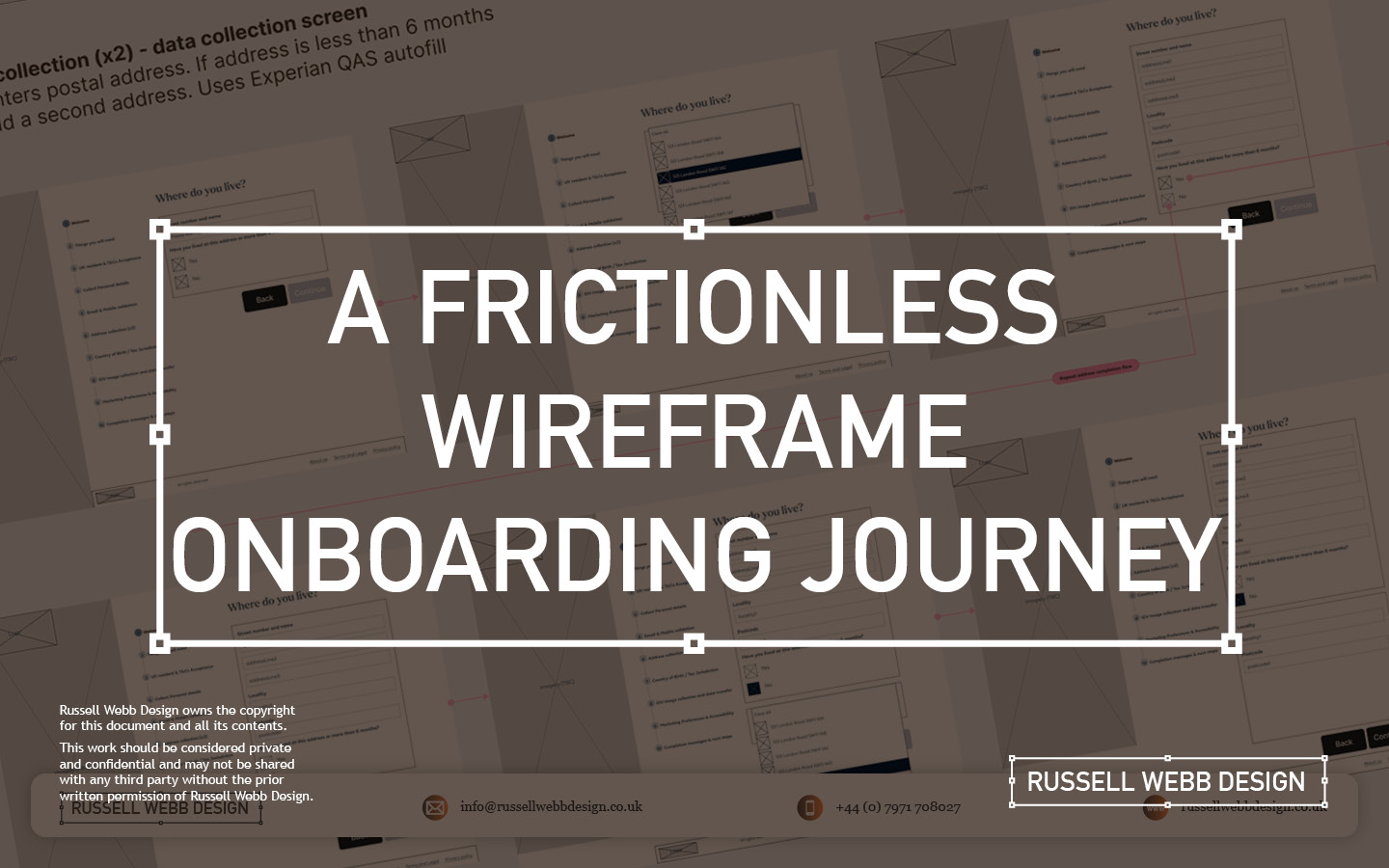
  • A Frictionless Wireframe Onboarding Journey

    A Frictionless Wireframe Onboarding Journey

    TL;DR: Customers faced a confusing onboarding maze. Detailed UX wireframes transformed it into a frictionless journey, getting users invested.

    OUTCOME: Secure, and personalised onboarding process building loyalty from the first click.
    UX Wire-Framing

    Multiple Interactions

    Design Thinking

    Enterprise

    How to hook new customers

    Detailed wireframes mapping a user-centred flow that included clear guidance, robust security, and personalisation resulting in a better customer experience, more efficient development, and strong team alignment..

    Backend to Frontend

    When customers make a product selection there is a lot going on behind the scenes. 

    The desktop new product onboarding experience is a complex animal, a prime candidate to wireframe. Capturing a large selection of unique steps and indicating the interaction design is a Design Thinking challenge and requires enterprise-level wire framing skills

    A Frictionless Wireframe Onboarding Journey
    A Frictionless Wireframe Onboarding Journey
    • Clarity and Understanding A central pillar in UCD
    • Take advantage of existing Design System component reuse 
    • Team alignment (from BAs to Dev to client)

    … let’s dive in


    Defining the Problem

    Security

    Hi-Fidelity

    A Frictionless Wireframe Onboarding Journey

    Imagine a new or existing customer discovering your product

    The onboarding process can often feel like a daunting maze. This is where detailed wireframes step-up, transforming a journey into a smooth and secure experience. Early decisions were made to leverage a pre-existing Design System, so high fidelity wireframes (Hi-Fi) became the way forward with Figma as the wire-framing tool of choice. 

    Development Preparation

    Pre-development tech checks

    Process flow diagrams

    A Frictionless Wireframe Onboarding Journey
    A Frictionless Wireframe Onboarding Journey

    The first goal in a wireframing process is technical. The objective is to integrate a robust data gathering mechanism into the onboarding process to streamline technical development. Understanding the terms and conditions, personal details collection, and email and SMS validation data flows and aligning these all to API calls was top-of-mind. 

    This early technical scoping ensures efficient API integration and data management solutions, so the team can move forward and then collaborate with BAs and then UX.

    Onboarding Flow and Requirement Gathering

    Goals

    Objectives

    Functional requirements

    Shared understanding

    A Frictionless Wireframe Onboarding Journey

    Images are blurred for client confidentiality reasons

    BA Requirements Gathering

    To provide a solid foundation, to limit rework and foster communication between stakeholders (users, developers, designers) a Business Analyst will typically conduct user and stakeholder interviews to understand business goals and success metrics, write user stories and generate Use Case Diagrams indicating functional requirements to create a shared understanding before wireframes begin.

    1 – Guiding the First Steps

    Personal details

    Pre-registration

    A Case Study in Wireframing Success

    The process begins the moment a product ID is entered as the customer clicks a product. These wireframes propose a gentle walk-through, hand-holding the customer and setting clear expectations. As personal details are collected, the system identifies pre-registrations, streamlining the experience. For unrecognised products, the UI gracefully handles the situation, preventing frustration.

    A Case Study in Wireframing Success
    Wireframes: From Investment Pledge (Source of Funds) to National Insurance (NI)

    Behance – A FRICTIONLESS WIREFRAME ONBOARDING JOURNEY

    A Frictionless Wireframe Onboarding Journey

    Fine tune the results

    UAT Testing

    Prototyping

    Sneak preview of the final delivered User Interface (UI) 

    The interface has been altered for client confidentiality reasons 

    The process is still fresh, typically these will go through Usability Testing and Heuristic Evaluation. Prototyping, with QAs on standard, is another option to verify and test stakeholder feedback.

    Conclusion and Impact

    Clarify ambiguity

    trust

    Tailored

    These wireframes don’t just showcase a process; they tell a simple story of a complex customer experience. By prioritising clarity, security, and personalisation, even with a level of ambiguity, this onboarding journey fosters trust and loyalty from the very first click.

    Empowering users with the financial tools they deserve. From Mastering Design Theory and Lean Agile, Solve big problems, fast to How delight and speed are rewriting our UX playbooks. See more Case Studies.

    Empowering users with the financial tools they deserve

    • Mastering Design Theory and Lean Agile
    • Solve big problems, fast.
    • How delight and speed are rewriting our UX playbooks

    More Fintech Case Studies

  • Using proto-personas to Know your user – Pt I

    Using proto-personas to Know your user – Pt I

    Execute a Content Audit using proto-personas to gain a deeper understanding of user needs. Consolidate personas, communicate findings, to achieve a deeper understanding of all users.
    Empower UX to move forward with experience maps to uncover user behaviour and emotions.

    Please note; for client confidentiality sensitive parts of all imagery has been pixelated. All work is copyright ©RussellWebbDesign 2024


    Hard Skills:

    Design Process

    Service Blueprint

    Proto-Personas

    Soft Skills:

    Service Design

    Journey Mapping

    Customer Experience Design

    Full List →


    Despite resource limitations, this Content Audit project successfully utilised proto-personas to gain a deeper understanding of user needs. By consolidating and refining persona data into meaningful ‘chunks’, and effectively communicating findings to stakeholders, all lead to a deeper comprehension of users for all involved. This empowered us to move forward with the next stage – using experience maps to uncover user behaviour and emotions.

    Limited Data, Maximum Impact

    Delivering with resource constraints and tight timeline, this Content Audit / Inventory Battle Plan leverages the power of proto-personas as the primary intel.

    Gather the troops

    Assemble all content audit data

    Regulated design environments are often constrained – it is important to offer agility and be resourceful. This level of Service Design would benefit from ;

    • Customer surveys
    • Stakeholder interviews
    • Analytics (rationalised down into meaningful chunks)

    …and additional data. For this UX project the starting point was an extended collection of unverified proto-personas. These were then rationalised in to bucketed or grouped personas.

    Navigating the complexity of proto-personas

    Despite resource limitations, this Content Audit project successfully utilised proto-personas to gain a deeper understanding of user needs. By consolidating and refining persona data into meaningful ‘chunks’, and effectively communicating findings to stakeholders, all lead to a deeper comprehension of users for all involved. This empowered us to move forward with the next stage – using experience maps to uncover user behaviour and emotions.
    Proto-personas: Adaptability in the face of organisational inertia and provide clarity to maintain stakeholder engagement.

    Adapt UX to audience and personas

    Larger organisations, often new agile methodologies, may still be in the early stages of embracing lean UX, so adapt your approach to your audience is a key skill.

    When personas are agreed and validated as the only ‘source of truth’ – there also must be alignment that these refine and adapt personas over time, ensuring that they remain relevant.

    Despite resource limitations, this Content Audit project successfully utilised proto-personas to gain a deeper understanding of user needs. By consolidating and refining persona data into meaningful ‘chunks’, and effectively communicating findings to stakeholders, all lead to a deeper comprehension of users for all involved. This empowered us to move forward with the next stage – using experience maps to uncover user behaviour and emotions.
    Overly detailed personas can dilute effectiveness, especially for large organisations. This task focused on consolidating personas for greater clarity.

    Focussed personas work well. Larger organisations multiply these audience types and their impact is reduced. This task looked at grouping and sorting by commonalities

    Conduct extensive desk research to develop a deep understanding

    Despite resource limitations, this Content Audit project successfully utilised proto-personas to gain a deeper understanding of user needs. By consolidating and refining persona data into meaningful ‘chunks’, and effectively communicating findings to stakeholders, all lead to a deeper comprehension of users for all involved. This empowered us to move forward with the next stage – using experience maps to uncover user behaviour and emotions.
    Embark on a deep dive of user research to become the brand’s go-to expert on your target audience.

    Absorb insights

    Take the time to listen and absorb – Become the brand’s knowledge hub.

    Absorbing insights and data is vital. Time spent at this stage of your research is key for informing a future IA.

    Dig deeper to understand your users problems, needs and goals

    Despite resource limitations, this Content Audit project successfully utilised proto-personas to gain a deeper understanding of user needs. By consolidating and refining persona data into meaningful ‘chunks’, and effectively communicating findings to stakeholders, all lead to a deeper comprehension of users for all involved. This empowered us to move forward with the next stage – using experience maps to uncover user behaviour and emotions.
    Experience maps are your tools to excavate the nuances of user behaviour, emotions, and motivations. Use this to win over their hearts and minds.

    Empathy-driven UX; Personas and experience maps

    By delving into the emotional landscape of proto-personas, designers can gain a deeper user understanding. This insight fuelled the development of a clear and empathetic experience map.

    Understand your audience types ; Their needs, aspirations, and behaviours. Commonalities and patterns will surface.

    Common Thread and Outcomes

    Despite resource limitations, this Content Audit project successfully utilised proto-personas to gain a deeper understanding of user needs. By consolidating and refining persona data into meaningful ‘chunks’, and effectively communicating findings to stakeholders, all lead to a deeper comprehension of users for all involved. This empowered us to move forward with the next stage – using experience maps to uncover user behaviour and emotions.
    By selecting the most crucial key phrases from the workshop discussions, I was able to distil the essence of each audience type and crafted them into a call-to-arms that galvanised the mapping stage

    Next steps

    By consolidating vast amounts of data into prototype persona groups, this Service Design approach conveys insights for stakeholders to digest, leading to deeper user understanding for all involved. This then informs the next stage, ‘Using Experience Maps to uncover user behaviour and emotions.’

    Please note; for client confidentiality sensitive parts of all imagery has been pixelated. All work is copyright ©RussellWebbDesign 2024

    RussellWebbDesign: Get your fill of UX trends, case studies and best practice
    Building a Wealth Management Super App

    CASE STUDIES

    Design with the dark mode trend front-of-mind

    Delight, speed and satisfaction are rewriting our UX playbooks in finance

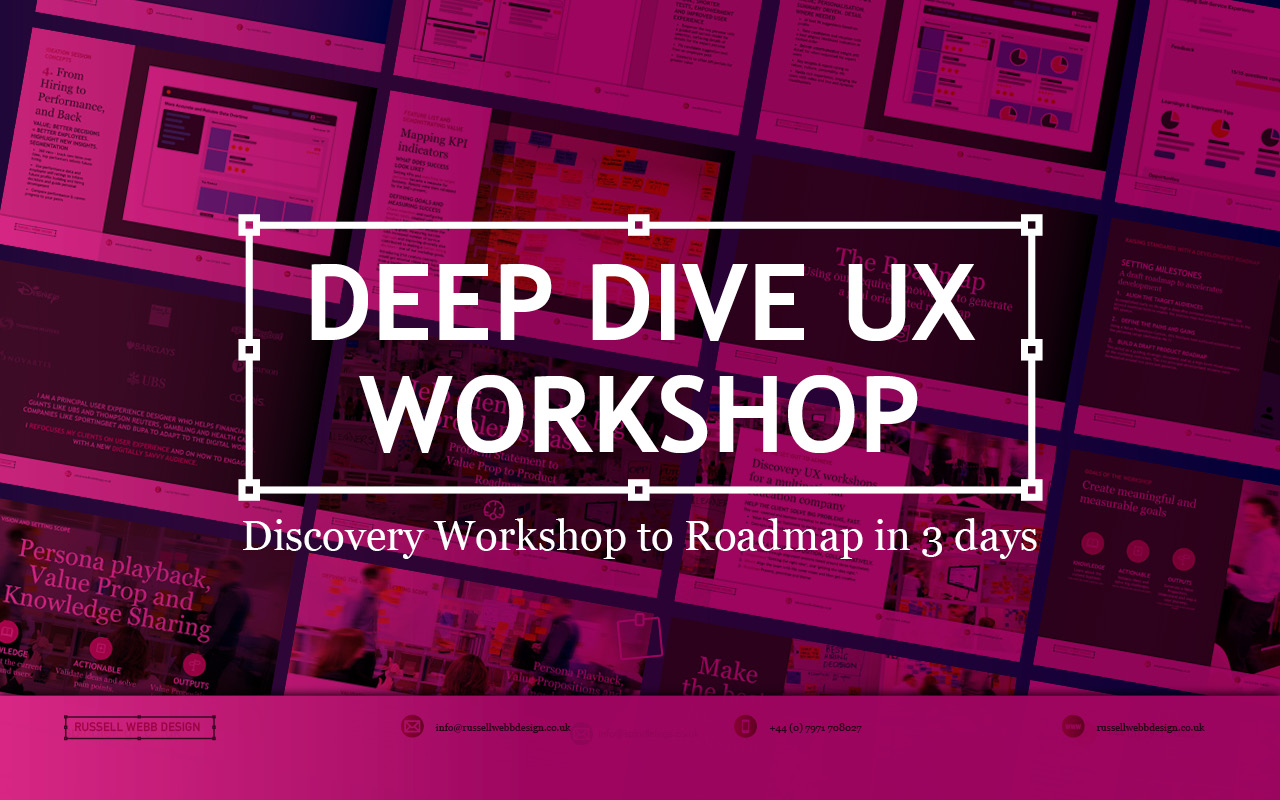
  • Discovery Workshop to Roadmap in 3 days

    Discovery Workshop to Roadmap in 3 days

    TLDR; Navigating Ambiguity
    Using workshop techniques I validated personas to surface a UI that promoted next steps for a Candidate Portal.

    Solving 3 big problems in 3 days; Aligning the target audiences through journey mapping, defining a Value Proposition and building a draft Product Roadmap.


    Hard Skills:

    Journey Mapping

    Research

    Visual Design

    Goal-oriented Roadmap

    Soft Skills:

    Empathy

    Collaboration

    Critical Thinking

    Full List →


    How to facilitate an ideation workshop around solving problems, understanding through ideation, knowledge sharing (based on agreed on personas)
    How to facilitate an ideation workshop around solving problems, understanding through ideation and knowledge sharing (based on agreed on personas)

    Help clients solve big problems, fast

    This user-centred and business workshop focussed on;

    • Business Problem Statement – The What
    • Value Proposition Statement – How to excite users / customers
    • Product Roadmap – Action/Next Steps

    What we set out to achieve

    Recently I was leading the Discovery phase for a multinational publishing, education & recruitment company. My prime objective was to facilitate the generation of a Value Proposition within a collaborative workshop environment based around three hypotheses;

    • Understand‘Getting the right idea’ and ‘getting the idea right’
    • Ideate – Align the team | Get creative
    • Roadmap – Present, prioritise and theme

    Defining Vision, setting scope

    How to facilitate an ideation workshop around solving problems, understanding through ideation, knowledge sharing (based on agreed on personas) and then attributing those personas, via SMEs validation, to surfacing UI to promote next steps plotted on a goal-oriented roadmap.
    How to facilitate an ideation workshop around solving problems, understanding through ideation, knowledge sharing (based on agreed on personas)

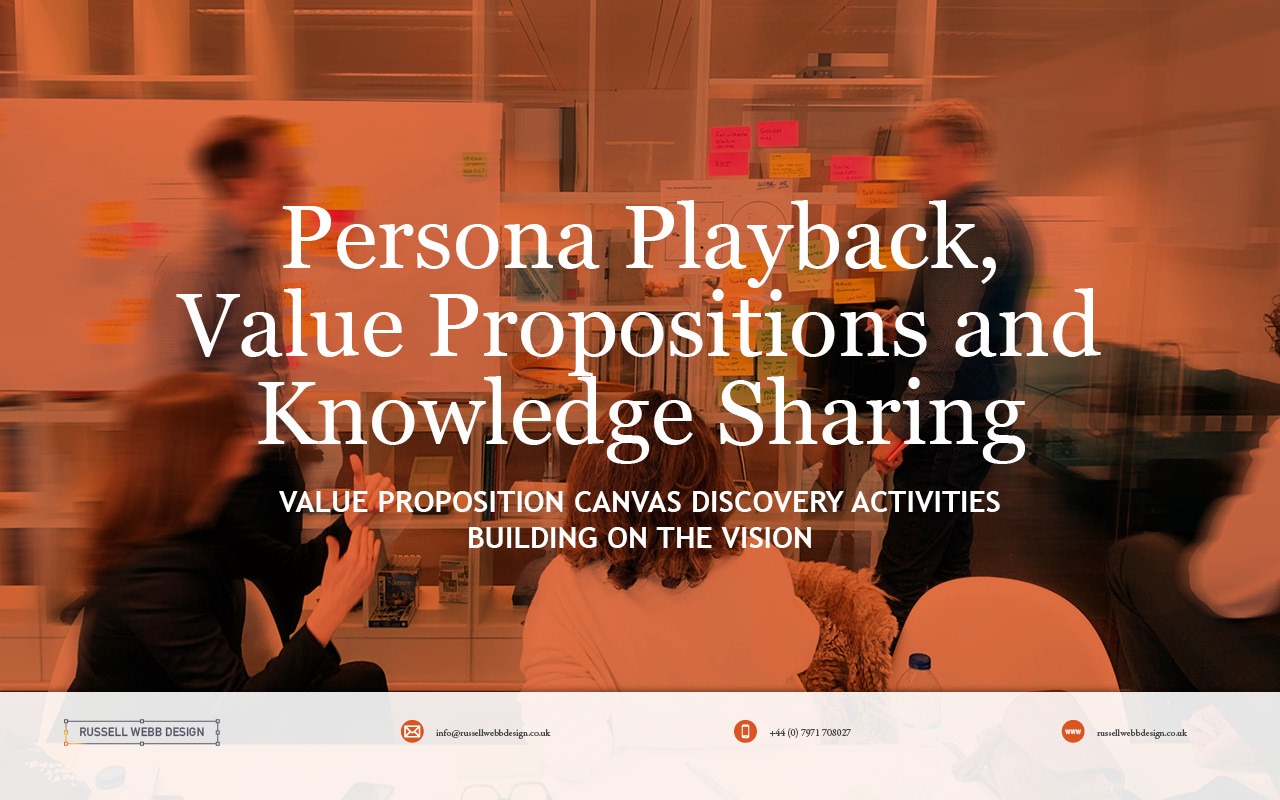
    Persona Playback, Value Propositions and Knowledge Sharing

    Validating Personas proved crucial. Early ‘Understand’ sessions proved invaluable in terms of getting to know the client’s ecosystem and getting closer to the overall workshop goals. Goals included personas improvements using a Value Proposition Canvas to expose misunderstandings, define Jobs To Be Done (JTBD) and Pains and Gains – more importantly it identifying key themes and services that would appeal to these personas. This ensured any misalignment did not cascade down to the Journey Maps on Day 2

    What we were trying to achieve using ‘Ask the experts’. Early touch points included attracting educational establishments and employers using baked-in services, plus having the ability to grow the market was paramount for particular personas. The client had the raw building blocks and the workflow for their ‘niche product for a niche market’, communicating that vision was the challenge.

    Customer Journey Mapping – Make the best hiring decision

    How to facilitate an ideation workshop around solving problems, understanding through ideation, knowledge sharing (based on agreed on personas) and then attributing those personas, via SMEs validation, to surfacing UI to promote next steps plotted on a goal-oriented roadmap.
    How to facilitate an ideation workshop around solving problems, understanding through ideation, knowledge sharing (based on agreed on personas)

    Gaining alignment across stakeholders on what making the ‘Best hiring decision’ journey looked like. Creating a visual representation of every experience a key persona(s) had with the client helped to tell a story, more importantly this led to a prioritised ideation list (visual solutions).

    Making the Best Hiring Decision

    • Initial stages – Planning and approval
    • Intermittent stage – Profile building, search and selection tools
    • Final stage – Interview, agreement and follow-on activities

    The exercise also highlighted a level of anxiousness, through to excitement and eventual relief. A truly valuable activity that presented opportunities that were eventually clustered and presented to the group as an adaptive Crazy 8 activity.

    Ideation and Roadmap

    Finally, this led on the most challenging section of the workshop, the Ideation Sessions. This resulted in 4 concept areas to prioritise on the road map and populate a timeline.

    Sketching can be scary!

    Demonstrate the steps to avoid a cold start.

    Push back on judgement calls and champion quantity over quality. All participants should take advantage of the knowledge in the room, bounce ideas off each other and improve through collaboration. A process of silent note taking, constrained to a page/large Post-It note, resulted in 4 principal concepts.

    Value: shorter tests, improve the UX

    Value: Personalisation. Summary driven.. 

    Value: candidate self-improvement.

     Value: better decision = better employees.

    Boosting Engagement

    Shortcuts to Success

    Shortcuts to Success

    • * Faster, more reliable tests: Reduce testing time and increase reliability
    • Personalised engagement: Tailor tests to individual needs, leading to higher engagement and lower churn.
    • Business-focused UX: Align testing with business goals by leveraging KPIs; Targeted feature development.
    Supercharge Testing

    Impactful Tests

    • Reduced client churn: Shorter, feedback-driven tests foster client satisfaction and retention.
    • Diversity in hiring: Objective, efficient testing helps attract diverse talent and improve hiring decisions.
    • * Shared Data; All backed up by a global database
    Boost diversity & retention

    Innovation for Early Adopters

    • * Modernise testing: Introduce innovative concepts too early adopters only.
    • Candidate quality and validity: Prioritise attracting the best candidates. Ensure test results are accurate and reliable.
    • Goal-oriented roadmap: Leverage learnings to craft a clear roadmap for continuous improvement.
    Better candidates | More valid results

    Goal-oriented roadmap

    Setting standards with a development Roadmap

    Solving big problems and setting milestones through a draft roadmap contributed to accelerating development across the current period and the next. Raise their internal products up to today’s standards was a priority. This roadmap was a significant step closer to this.

    3 big problems in 3 days

    Align the target audiences 

    We did this across the group early on through a deep-dive personas playback session. This proved essential both to enable the journey map but also assigning value in the KPI session.

    Define the Pains and Gains

    This was accomplished with a Value Proposition Canvas. A useful business tool to surface Pains and Gains and Jobs-To-Be-Done

    Build a draft Product Roadmap 

    This acted as a our North Star and as a high-level visual summary of the workshop outcomes; Two development streams; Two principal personas.


    As a value-add, a UX / UI Report consolidating all data was generated, highlighting the groups new findings and areas for improvements to inform future Timelines and Roadmaps.

    RussellWebbDesign: Get your fill of UX trends, case studies and best practice

    Discover high-impact UX case studies

    Portfolio case studies describing design, my UX process, and business impact.

    From boosting user adoption in fintech, to improving trust with responsible gambling through to retaining Millennials in the world of ‘digital lotteries UX’ to leveraging key USPs for mobile healthcare.

  • Power up your designs with dark mode trend front-of-mind

    Power up your designs with dark mode trend front-of-mind

    Delight, speed and satisfaction are rewriting our UX playbooks in finance. While at the bleeding edge of this digital transformation, a modern UX-er has rapidly emerged, changing the rules of the game.


    Hard Skills:

    Journey Mapping

    Research

    Visual Design

    Soft Skills:

    Empathy

    Collaboration

    Critical Thinking

    Full List →


    Strong UX has taken modern banking to the next level

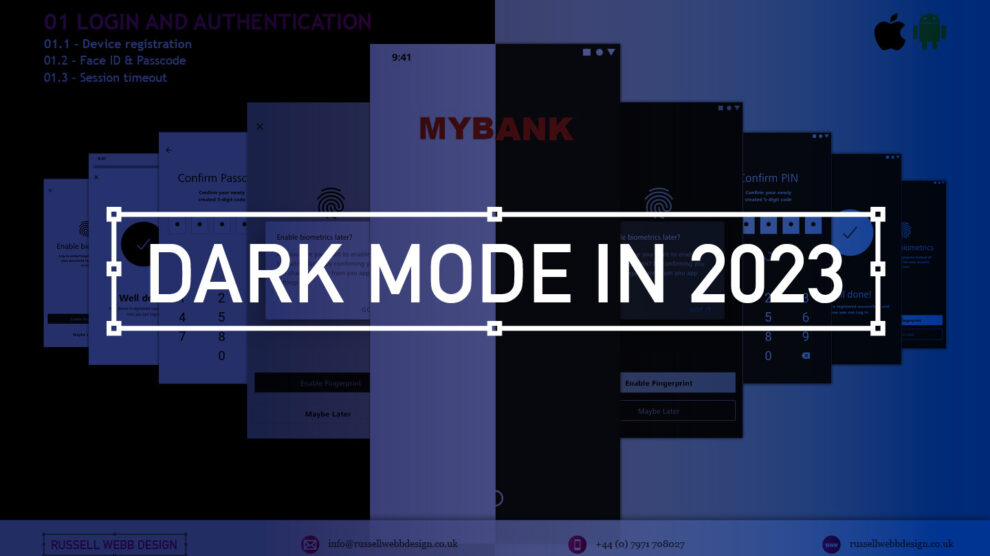
    Designing an ecosystem that can scale to deliver multiple connected products is really the ultimate UX/UI case study. Part of that skill-set is the new must-have that is dark mode.

    Here is my take on this new visual aesthetic.

    MYBANK* Europe – 3.8 million retail banking clients

    This case study is based on MYBANK*. As part of a broader digital transformation, I led full-throttle Discovery sessions laying the UX foundations for this region’s third-largest banking group, with total assets at CHF 229 billion;

    • 120-person strong team
    • 1-2-1 Leapfrog Workshop
    • A demanding 3rd party agency

    Goals and How-to retool

    The goal here is to give back to the design community a mindset for transitioning handcrafted light-mode UI, to the dark side. As this mode has become the new black, UX / UI designers need to re-tool themselves with the skills to set effective palettes, to design in context and to know the rules or at least know how to break them.

    Using dark mode as default

    Designing with a predominantly dark palette, swapping out light backgrounds, lightning text and icons has more recently become a non-negotiable design requirement with today’s clients. For mobile I get it, all apps should have both light and dark UI — or day and night themes that switch automatically. But what happens when your users are purposely choosing dark mode – all the time?

    How dark mode has crept up on us

    Early computer systems were always in dark-mode as characters were inverted. The Mac brought WYSIWYG and what we now know as light mode, or ‘printed paper’ mode. This became the default, with designers rarely even thinking about other colour palettes.

    Although prevalent in certain digital environments, ‘dials-and-lights’ interfaces (car dashboards spring to mind) have always been dark, controls and readouts follow established dark patterns.

    An app with a dark palette consumes as much as 90% less energy, especially with AMOLED screens. For battery saving reasons there is enough justification for your clients to build in design capacity for this mode. Be mindful of your users’ environment, a bright rectangle glaring at them in a dim room is not good.

    Most streaming-video services default to dark mode as users do much of their viewing at night. This is why TV have dark bezels – right? Dark backgrounds reduce the overall brightness of the display, so can be used in any lighting condition. A typical dark-mode page is five times less bright than exactly the same content in light mode.

    Defining a dark colour palette 

    Designers have been reducing contrast in light-mode for years.

    Black text is rarely black anymore
    (and not just disabled text)

    Note the emphasis is on contrast. The term colour contrast is misleading. To give context, let’s map out a mini deep-dive on colour theory.

    Quick recap on colour theory

    • Hue—The spectrum on which a colour appears.
    • Saturation—How intense a hue appears.
    • Brightness—The amount of black or white that is added to a colour.

    To most designers, developers, and product managers—the term colour means the hue part only. Red or green, for example. Contrast implies that contrast relates to hue, but it does not. Contrast indicates the difference in brightness levels of two elements. 

    Small differences equal low contrast, large differences high contrast – so contrast is a comparison.

    Contrast in Dark Mode

    When dark-mode palettes are implemented properly, their low overall output should provide extremely high contrast, without anyone on a project team worrying that the display is too harsh.

    But you still need to keep the contrast as high as possible, which trips up a lot of designers. Dark-mode design suggestions, guidelines and inspiration sites too often throw away everything we know about colour theory, especially; 

    • Contrast
    • Visibility
    • Readability
    • Universal design

    Don’t start with a black palette

    A quick, easy way to start creating a dark palette is to create shades and tints of all your colours.

    Keep the hue and saturation, change the brightness.

    Colour theory tip

    • Shade = adding black to the colour.
    • Tint = adding white i.e, pink is a tint of red.

    How-to build a powerful dark colour palette

    1. Choose another dark colour from the palette as a background (or make a shade of one)
    2. Create shades of all your colours i.e. adding black to the colour.
    3. Use a number of dark hues for backgrounds making branded elements pop.
    4. Instead of just using lines or grayscale, use various dark shades of the brand’s principal colour to set-off sections.
    5. Finally, check contrast in a dark room with real users.

    Even Google suggests very dark, highly saturated accent colours, but with lots of very low-contrast, grey backgrounds. Discarding simple lines around card edges and replacing them with dark-grey backgrounds doesn’t solve the contrast argument. Of course, this is just one opinion (albeit the worlds’ largest search company)white key-lines can work as well.

    Grey is not the only fruit!

    Hollow icons for available tabs and solid icons for the selected tabs, while not a colour theory issue, is an effective way to differentiate them. Using simple text for tabs, in grey or red is an issue for the colourblind, not acclimated to night or glare.

    Bad contrast impairs readability and users become confused when part of the page scrolls, but other parts do not. Contrast and differentiation is not just text and icons but the entire experience.

    Conclusions on dark mode UX

    Enable iteration by employing a high-impact Design System with global reach

    Personalising a gold-standard, multi faceted, flexible Design System, empowering over 220 global organisations, employing a 6 sections, over 500+ components, catering for 3 industry-standard digital platform

    From foundational elements like typography, to light and dark colour mode across all tokens, icons and logo, a rich library of icons to container, cover and sheets, to selectors components, drop downs, empty states, models, navigational and informational elements.

    Modern UX designers should champion dark mode as the default option for mobile apps. Embracing this trend not only aligns with user preferences but also enhances the app’s visual appeal and overall user experience;

    Not just about style

    Design choices such as a colour palette have enormous implications around usability and perception.

    Design basics

    Size, spacing, and contrast in dark-mode are still critical.

    Test, test and test again

    Don’t forget to test your solution in a real-world environment (i.e a dark room). Try to understand how people would use your product, and make sure you’re designing for their context and their needs.

    RussellWebbDesign: Get your fill of UX trends, case studies and best practice